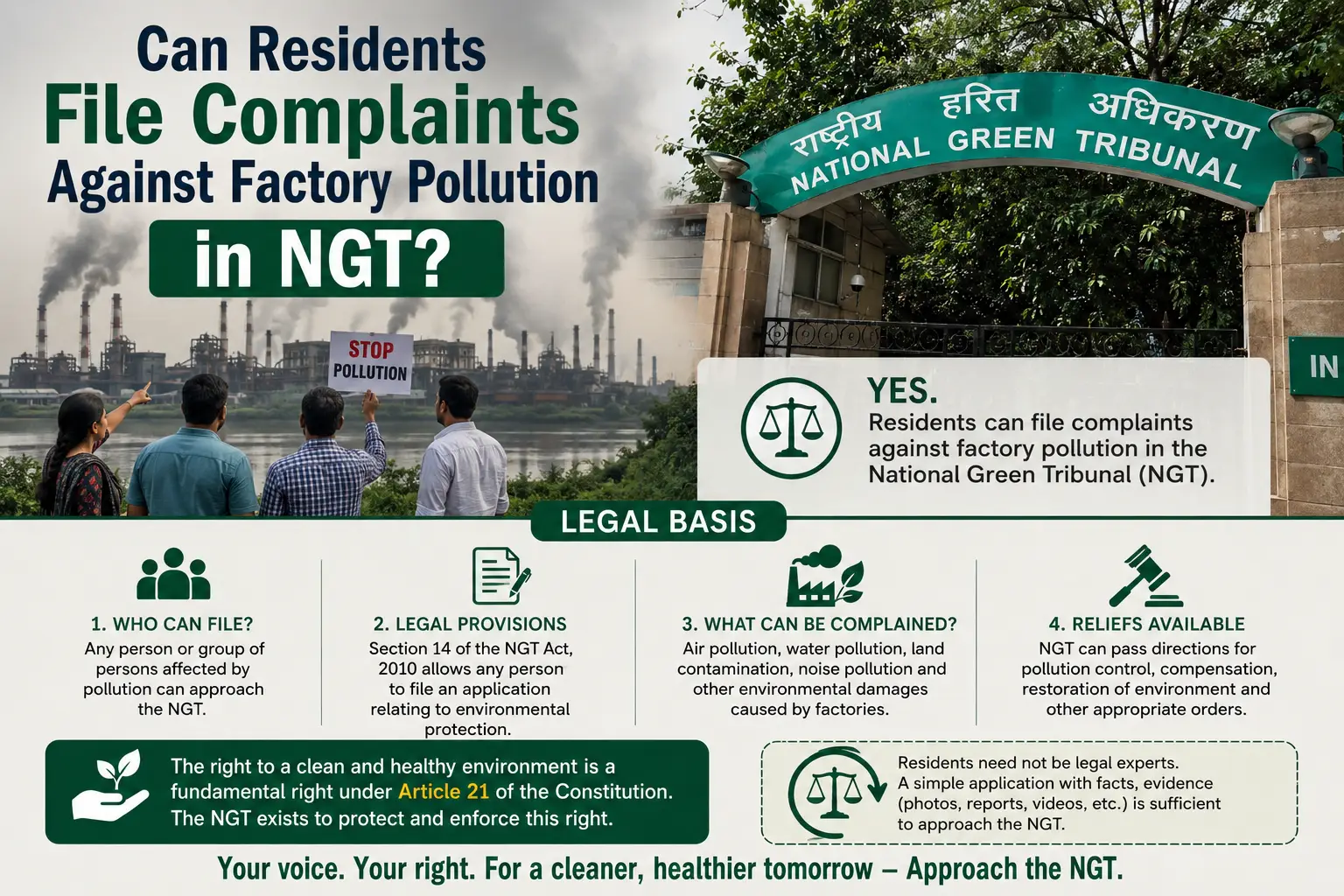
A factory pollution complaint NGT matter often starts with something ordinary but profoundly disturbing. Smoke coming into homes. Night smell of chemicals. Black dust on the balconies. Drain runoff of dirty water. Children coughing again and again. Elderly people who have trouble breathing. Month after month, residents ignore these signs because a factory is too powerful to fight. The truth is the opposite. Residents can lodge complaints about factory pollution in India. If the pollution leads to environmental damage, public health impact, air or water contamination, or violation of environmental standards, residents can file complaints with the Pollution Control Board and, in appropriate cases, the National Green Tribunal. In my experience, the loudest cases aren’t always the strongest pollution cases. They are the best documented . Photos and videos, copies of complaint letters, medical records, water test reports and clear dates can make a big difference. A complaint should not merely be an expression of anger. Facts Damage Legal Violation Relief required. Yes, if industrial activity leads to air pollution, water pollution, hazardous waste dumping, chemical leakage, illegal discharge, groundwater contamination, noise pollution or environmental damage, residents can file a factory pollution complaint NGT case. You don’t need to own a factory, land or commercial unit to raise the issue. You have the right to complain if the pollution affects your home, health, family, neighbourhood, source of water or local environment. The National Green Tribunal deals with major environmental disputes. That means the complaint shouldn’t be about a simple fight with a factory owner. The matter should concern environmental damage, risk to public health, violation of pollution control standards, industrial pollution, illegal dumping of waste or failure by the authorities to act. For example, if a factory emits smoke every night and residents nearby are suffering from breathing problems, that can be a major air pollution complaint for the activity of that factory. If chemical water flows untreated into a public drain or nearby water body, residents may seek legal action for water pollution in India. If a factory stores or dumps hazardous industrial waste near residential houses, residents are entitled to file an industrial waste pollution case. One affected resident can complain. A group of residents may also register a complaint. If pollution affects a colony or locality, then a residents welfare association can also take action. In many cases, a group complaint is more effective because it demonstrates greater harm to the public. Factory pollution isn’t only black smoke from a chimney. Pollution in the real world can be many things. "Some see it. Sometimes they get a smell of it. Sometimes they sense it in their health. The usual types of factory pollution are: Initially, many residents regard these problems as a normal inconvenience. That is a wrong thing. Pollution, if it continues, can affect respiratory health, drinking water, soil quality, children, senior citizens, animals, plants, and the long-term safety of the neighborhood. I see this happen in real life so often: residents smell a strange smell, but not until evening. During daytime inspection, everything looks okay. The factory looks clean. But at night the fumes start again. In such a matter, residents should record timing, date, video, smell pattern and health impact. Night pollution is pollution. Another typical example is water discharge. Early in the morning or late in the evening a factory may discharge coloured water into a drain. Water may look blue, black or foamy as it flows near homes. If this water enters a local drain, pond, agricultural land or groundwater channel it can become serious. Yes, in many cases. Commonly, the initial step in practice is a pollution control board complaint. Residents can file a complaint with the State Pollution Control Board or Pollution Control Committee and request for inspection, sampling, action report, and immediate directions against the polluting factory. Complaint to Pollution Control Board helps in three ways. First, it gives you an official record. This shows that people did not keep quiet. Secondly, it gives the authority a chance to inspect the factory and check compliance. Third, if the authority does not act properly, residents can later show that the regulatory body ignored the grievance. But residents should not wait for ever if the pollution is serious. If the pollution does not stop despite complaints, if the board does not act on complaints, if the factory continues to operate illegally or if public health is at stake, residents may go to NGT. The facts dictate the best course. Sometimes a loud complaint to the Pollution Control Board works. Sometimes it doesn't. NGT intervention may be required in serious matters. If there is a substantial question relating to environment, the residents can approach the National Green Tribunal. This category includes factory pollution cases when pollution affects air, water, land, public health or ecological balance. In cases involving residents, NGT may be approached in: “NGT Case on complaint of pollution by factory should be drafted carefully. The complaint must describe the pollution and damage, identify the polluting facility, note any earlier complaints and request specific relief. The case may be weakened by vague allegations. It is backed up by clear facts. Evidence is the basis for any industrial pollution complaint. Residents often say, ‘Everyone around here knows the factory is polluting.’ That may be true, but legal forums need material, not just local talk. The following evidence is useful: “Residents should gather evidence legally. DO NOT ENTER FACTORY PREMISES WITHOUT PERMISSION In English it is: “Don’t make conflict. Never threaten employees. “Do not barricade streets unless directed by legitimate means. Gather evidence from your house, public road, common area, drain, balcony, terrace or any place where you have legal access. I find a simple evidence diary very helpful. The residents can keep the date-wise record as given below: Date of pollution incident Time of the incident. Pollution type observed. Photo/Video Reference Effect on health, if any. Complaint, if any, lodged. Names of affected residents. That kind of record shows a pattern. A pattern is more important than a one day complaint. People often search for how to file complaint in NGT because they are looking for a simple online form. “Now, that’s not really what happens. Normally, a complaint before the National Green Tribunal should be properly drafted and should contain correct parties, legal grounds, documents, affidavit and specific reliefs. What should a good NGT pollution case India complaint contain: The complaint must clearly explain how the matter involves environmental harm. It shouldn’t sound like a personal fight. It should link factory activity with pollution and damage. For example, instead of just writing “the factory is causing trouble”, the complaint should say: The factory emits black smoke from 8 pm to 11 pm. Smoke seeps into nearby houses. The Pollution Control Board receives complaints from residents with specific dates. There has been no effective step. Children and old people are struggling to breathe. Photos and videos attached. People want inspection, emission testing and directions to stop illegal pollution. Such drafting provides the structure of the complaint. If a resident complains of pollution from a factory, they may have to make the polluter a party. Depending on the facts they may also need to include the State Pollution Control Board, municipal authority, district administration, Industrial Development Authority or other concerned Government Department. The parties involved are important, as the NGT can ask authorities to submit reports. The matter may be incomplete if the responsible authority is not included. Thus in a case of industrial waste pollution the Pollution Control Board may have to inspect the factory and submit a report. In the case of water pollution relating to drains, the municipal authority may also be relevant. If it’s a land use case or an illegal industry in a residential area, you may need the local development authority. Residents are to demand relief in practical terms. “The NGT is not approached just to punish a factory. Its main purpose is to stop pollution, protect the environment, ensure compliance and restore damage. In case of dispute, residents may request: The relief must match the evidence. If evidence of smoke is found, residents should seek air pollution detection and emission reduction. In case of discharge of polluted water, they should get the water tested, stop discharge and restoration. In case of waste dumping, they should pursue removal, safe disposal and action against the violation. Weak factory pollution cases can result from avoidable mistakes. I have seen residents waste time and energy doing things emotionally and not strategically. Mistakes are commonly: Another mistake is putting all your eggs in the social media post basket. Social media can put pressure on, but can’t replace legal action. A good complaint with supporting evidence will go much further than angry posts. A small industrial unit near their colony was spewing out thick smoke, a group of residents noticed. Usually the smoke came in late at night. Children began to cough and the old people were complaining of difficulty in breathing. First the residents complained verbally. But nothing happened. Later they started recording videos with date and time. They gathered medical prescriptions, photographs of black dust on windows and copies of written complaints sent to the Pollution Control Board. The case was stronger when the record was clear. The point is clear. Don’t rely on memory alone. Document in writing and photographically. In another common scenario, residents saw coloured liquid being discharged from an industrial unit into a public drain. The water smelled strongly of chemicals The factory denied any responsibility. Residents took pictures and video from a public road. They filed a written complaint with the pollution control board. They also took a water test report privately as well. Their legal case relied on inspection, testing, halting the discharge and action under environmental rules. This was an improvement on simply saying "the factory is polluting". The residents demonstrated what was happening, when it was happening and why official action was necessary. Factory pollution is not just an environmental problem. It’s a human problem. Dignity, health and everyday life are linked to clean air and clean water. No family should have to close the windows every night because of chemical fumes. Children should not be brought up on industrial dust. People should not be afraid to drink their ground water because a factory is dumping waste nearby. Pollution does not stay within factory walls, so environmental rights of residents matter. It moves through air, water, soil and drains. A whole locality can be affected by one factory. Many people live with pollution because they think going to court is too expensive, too complicated, or just not worth it. That’s not always the case. A good complaint can prompt authorities to inspect, report and act. Good documentation can protect the factory from denying everything even if the case takes time. NGT Lawyers help residents, resident welfare associations, affected families and communities in factory pollution complaint NGT matters. Normally the work will begin with fact review. What type of pollution is occurring? Which is the factory? What's the evidence? Which authority has been notified? Did the Pollution Control Board act? Is the matter fit for the NGT? Having considered the facts, the legal strategy may involve: Every pollution problem doesn’t have to go the same way. NGT needs to take urgent action in some cases. Some need a good complaint to the Pollution Control Board first. Some require both. A practical legal assessment can save wasted time. Yes. If the factory pollution causes environmental damage, public health risk, air pollution, water pollution, hazardous waste issues or other substantial environmental harm, residents can file a complaint before NGT. In many cases it is useful to file a pollution control board complaint first because it creates an official record. However, residents may consider NGT action on legal advice in urgent or serious situations. Photos, videos, copies of complaints, medical records, witness details, date-wise pollution records, air quality reports and any inspection report from authorities are all useful evidence. Yes. If a factory discharges untreated effluent, pollutes drains, pollutes ground water or affects local water sources, residents can take legal action against factory pollution. In appropriate cases NGT can issue strong directions including action against illegal or polluting operations. Facts, evidence, inspection reports and legal violations are the factors that determine the final order. Yeah. In appropriate cases, one affected resident can file a complaint. A residents welfare association or a group of residents can also file if the pollution affects a larger community. Wherever available, filing with NGT may be done through the e-filing processes . But the petition still needs to be properly drafted with documents, parties, affidavit and specific reliefs. Where appropriate, directions for environmental compensation and restoration may be sought. Personal compensation is only paid if there is proper proof of damage, health impact or specific loss. Residents should carefully record night-time pollution. Videos, dates, timings, smell records, medical papers and complaint copies can help prove pollution is happening outside normal inspection hours. NGT Lawyers can prepare complaints, draft NGT petitions, identify correct authorities, structure evidence and guide residents through the legal process, review facts. NGT matter on factory pollution complaint should never be taken lightly. Pollution affects health, home, water, air and future of a locality. Residents have rights, but those rights are effective only if the complaint is correctly prepared. If your neighborhood has factory smoke, chemical smell, untreated discharge, hazardous waste, industrial dust, noise or groundwater contamination, start documenting the problem right away. Keep copies of complaint. Dates. Collect evidence legally. Speak with other affected residents. Then take informed legal action. NGT Lawyers led by Advocate BK Singh assists residents and affected communities with issues of environmental law, complaints regarding factory pollution, complaints to Pollution Control Boards and National Green Tribunal cases in India.Factory Pollution Complaint NGT: How Can Residents File Complaints Against Factory Pollution?
Can a resident file a complaint against factory pollution in NGT?
What is pollution from factories in India?
What if Residents First Files a Complaint with the Pollution Control Board?
When can residents contact NGT?
Need evidence for industrial pollution complaint
NGT: How to file complaint against factory pollution
Who should be made a party to the complaint?
Reliefs for residents in NGT
Common Errors Residents Make
Mini Case Study Example 1: Smoke from a Factory Near Residential Homes
Mini Case Study 2: Chemical Water Going Down the Drain
Why Residents Care About Factory Pollution Complaints
Role of NGT Lawyers in Factory Pollution Cases
Factory Pollution Complaint NGT FAQs
Yes, the residents can file complaint against the factory pollution in NGT.
Do I need to complain to pollution control board before approaching NGT?
What evidence is required to lodge a complaint about air pollution from factory operations?
Can the residents complain about the water pollution from the factory?
Can NGT direct closure of polluting units?
Can a person file a complaint in National Green Tribunal?
Is NGT complaint online registered?
Can factory pollution lead to lawsuits from residents?
What if the factory only pollutes at night?
How can NGT Lawyers help in industrial pollution complaint?
Final Thoughts:
There's no reason for concern. There is no difficult-to-understand legalese.
Someone who has helped many people with the same problems gives you clear, honest advice. We want to make the legal process easy to understand and use for everyone.
Schedule Your Consultation