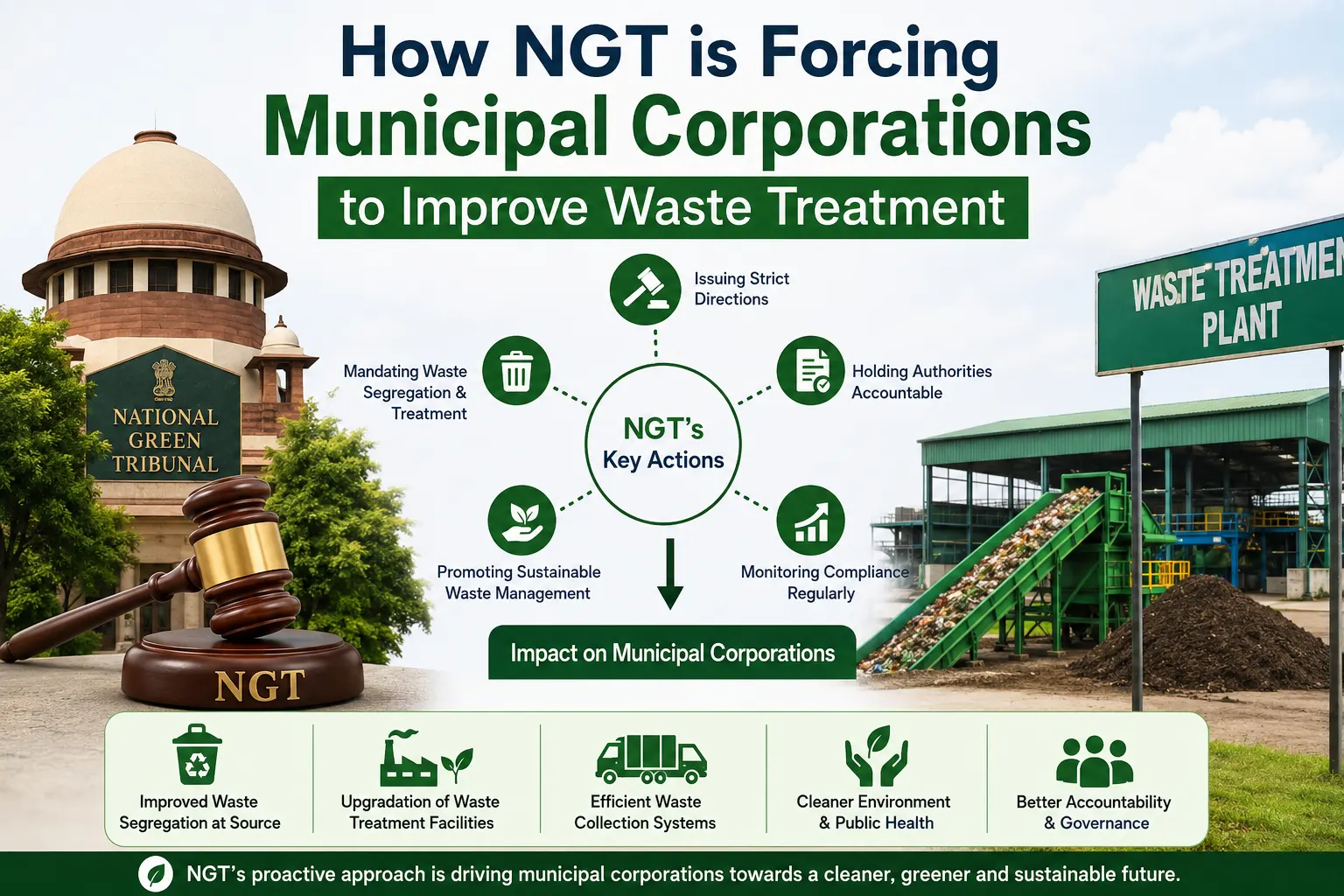
Do overflowing garbage points near your society annoy you? Does the smoking landfill behind your colony worry you? Does sewage-filled nullah running past your office agonise you? Does dumping of waste at open space in residential colony trouble you? If you answered yes to any of the above questions, then you already understand why solid waste management rules have become serious business for the National Green Tribunal over the years. Waste is now much more than just governmental responsibility. It concerns your health, property prices, groundwater, air quality, everyday life and let’s be honest – your dignity. For years now, NGT has been nudging municipal corporations, municipal councils and urban local bodies to wake up to treating waste management in their areas as more than paperwork. 2026 has been especially busy because Solid Waste Management Rules, 2026 came into force recently on April 1, 2026 superseding Solid Waste Management Rules, 2016 . These rules aim to implement 4-stream segregation at source, online monitoring of waste management infrastructure, Waste Facility audits, stricter responsibilities for urban local bodies and bulk generators of waste and environmental compensation for violations. As citizens, resident welfare associations (RWAs), industries, commercial buildings, institutions and families living near garbage dumps and waste treatment areas, what does this mean? If you can understand one thing from this post, let it be this – municipal corporations not treating waste properly can now be challenged more effectively with legal backing. Improper waste management doesn’t seem alarming on day 1. Garbage at many places near a drain on day 1. Garbage dumped by mixed garbage trucks in piles on day 1. A landfill catching fire that everyone assumes will settle down by evening on day 1. But as days turn into months and months into years, these little violations add up to create health hazards for the public at large. In my experience, most people consult with an environmental lawyer after they have waited for a while and felt that they have no other option but to go legal. First, they write to the municipal office. Then they send some pictures. Then they tag officials on social media. Then they wait for eternity. Still nothing happens. People come to me when the issue is out of hand: foul smell, mosquito menace, groundwater contamination, fires on dumpsites, overflowing drains, diseases and sometimes school children or old age residents falling ill. That is where NGT comes into the picture. NGT does not treat municipal waste management problems simply as a cleanliness issue. The Tribunal looks at larger environmental non-compliance issues. Improper collection, segregation, transporting, processing and disposal of waste can bring in questions of Article 21 of our Constitution includes the right to health and a wholesome environment as a fundamental right. Under the National Green Tribunal Act, 2010, it has been mandated to See more about NGT Act here. This is how cases related to garbage dumping spots, landfill fires, untreated leachate spread, sewage entering drains due to mixed dumping, industries not following solid waste disposal rules, construction waste not treated properly, dumping of e-waste in unauthorized areas and municipal corporation failures at waste treatment come under the jurisdiction of NGT. If NGT takes suo moto cognizance of a matter or receives an application regarding the failure of a municipal corporation to treat waste properly, it usually does not take the statement “we are trying our best to resolve the issue” at face value. As a general practice, the Tribunal will ask for records and reports. As litigation experience has shown over multiple NGT waste management cases, municipal corporations now need to show online dashboards of performance, comply with tighter solid waste management rules and treat waste or face environmental compensation orders. Many urban local bodies had been operating waste management facilities under solid waste management rules 2016 . Despite well-defined laws, our cities produced more waste than ever. Our waste generation kept rising, but the mindset of managing waste didn’t keep up. Infrastructure couldn’t match growth. Compliance was selective. NGT stepped in where needed, but many smaller violations went unnoticed until now. The solid waste management rules, 2026 lay down sharper parameters. Solid Waste Management Rules, 2026 were notified by the Ministry of Environment, Forest and Climate Change on January 27, 2026 and came into force from 1st April 2026. These rules supersede Solid Waste Management Rules, 2016. Here are the major changes affecting municipalities: Residents have to segregate wet waste, dry waste, sanitary waste and special care waste separately. Mixed waste handling is prohibited by law unless under exceptional circumstances allowed by the State Governments. Households have to store dry waste in covered containers while waste from bulk generators like restaurants, hotels, societies and markets also need to be stored in closed containers before collection. If you generate construction waste, send waste offshore or are an producer, you need to read these rules carefully. Your responsibilities have increased significantly. Detailed rules have been specified for processing facilities, the role of local bodies now includes managing segregation, collection and transportation only in respect of coordination with processing facilities or Common Waste Processing Facilities, Material Recovery Facilities, recycling facilities and landfills now have defined roles while biomining and bioremediation of legacy waste are now mandated by law. The biggest change since 2016 is how waste has to be segregated. Previously, cities talked about wet waste and dry waste collection. Now there are 4 streams of waste. This means municiaplities have a much tougher compliance standard. Instead of only collecting and dumping waste, local bodies now have to show how they are collecting, segregating, transporting segregated waste, sending it to the right processing facilities, restricting dumping in landfills, auditing processing facilities, maintaining online records and implementing plans to retro-fit waste treatment of old dumpsites. Another noticeable change is official recognition of Material Recovery Facilities. Material RecoveryFacility is now recognized as facilities which sort solid waste. Collection, segregation and transportation remains responsibility of local bodie in coordination with such facilities. The biggest change for citizens is strict online monitoring. Petitioners have downloaded dashboards of the Centralised online monitoring system to Court before. Solid Waste Management Rules, 2026 provide for compulsory online tracking of – All processing facilities will need to submit online reports of how much waste they handle and audits will take place to assess compliance. Instead of just hiding behind vague words, municipal corporations can now be challenged because non-compliance will become visible. Environmental compensation amounts have been specified for violations under the Polluter Pays principle. This includes compensation for false reporting, forged documents and even operating a processing facility without the required registration. If NGT passes an order for environmental compensation against a municipal corporation for example improper waste treatment or enforcement lapses, it becomes a financial matter for local bodies. They have to pay. They tend to listen more. Can NGT really take action against municipal corporations who do not treat waste properly? Yes. Can they listen to citizens everyday? Of course not. But they will act when enough cases are filed. When municipalities treat or fail to treat waste in violation of Solid Waste Management Rules, the following tools can and have been used by NGT in the past – These are usually ordered by NGT when complaints of landfill fires, sewage mixed dumping due to inadequate garbage dumps, medical waste dumping in residential areas, non-functional waste processing plants or general grievances of municipality not treating waste reaches NGT. The Tribunal may direct the joint committee, State pollution control board or panel of experts, district magistrate or even the local municipal authority to inspect the site and file a report on the ground reality. If there is a legitimate complaint against a municipal corporation that it is not treating waste properly, NGT may direct the municipal body to file an affidavit showing quantities of solid waste generated per day in the area it serves, quantity being collected, quantity being segregated, quantity being treated or processed, quantity of untreated waste and lastly a remediation plan for legacy waste with timelines. This alone has been enough in many cases to get municipalities moving. Not only can civil fines be imposed by NGT on erring municipalities, NGT can order environmental compensation under Environment (Protection) Act, 1986 . Since this compensation goes to the State Treasury, municipal corporations take these orders seriously. A lot of municipalities make promises orally in NGT. To avoid this, NGT can attach conditions like filing periodic status reports, ordering personal appearance of officers from municipal corporation, undertaking new inspections, ordering new affidavits that may be reflected on the online SWM dashboard. NGT can order state pollution control boards and state pollution control committees to take cognizance of complaints. Since these bodies have technical expertise, NGT will usually ask them to calculate environmental compensation amounts in most waste related complaints. Not many know this but solid waste management can also be linked back to our fundamental rights when there is enough cause. In one solid waste matter from Delhi, NGT remarked – This information clearly indicates that the solid waste generated in huge quantity, if left untreated, destroys the environment and also directly affects the right of citizens to enjoy pollution-free water and air and constitute a serious threat to their fundamental right to life under Article 21 of the Constitution of India.” NGT further added – We notice a serious gap between the amount of solid waste generated daily in Delhi and the currently available processing capacity. The record indicates that around 3,000 metric tonnes of untreated solid waste gets generated everyday.” Judgment followed: The people of Delhi know all too well how garbage can pile up and create health hazards. While exact numbers can be debated, NGT noted in the above order that solid waste generated in Delhi was estimated to be more than 11,000 metric tonnes per day while the MCDs had only about 8,073 metric tonnes per day dedicated waste processing capacity. That means theoretically, untreated solid waste was accumulating by more than 3,000 metric tonnes every single day in Delhi. Imagine how much that adds up to in a year! Had the matter gone any longer, NGT warned Delhi could have faced a health emergency situation. The case illustrates the scale of municipal waste treatment failure in Delhi. For smaller cities with less infrastructure, the problem is just as bad if not worse. Takeaway for citizens – Keep evidence of garbage complaints handy. Documentation is stronger than just Google maps photographs. Keep your files of complaints sent to municipal corporations. RTI requests that show how much waste is generated versus how much waste is being treated in your area are strong evidence. Keep proof of outreach you have done and lax responses you have received. Judgment followed: If you want to know how municipal corporations will defend themselves, this is a good case to read. Here, the Municipal Corporation Jalandhar replied to the NGT saying that – The work schedule was revised as per requirement and finally, tenders were issued for waste processing facilities for the treatment plant having proposed capacity of processing 500 metric tonnes per day which is aligned with the estimated quantity generated.” Do notice the details. Basically, it gave assurance that they would look forGPS monitoring of trucks buy machinery and sort it out. Instances like these show you what municipal corporations say. They have a reason for everything. Funds are allocated, records are assigned, documents are shown. But what does the common citizen see on the ground? Municipal corporation promoting programmes are not enough when garbage burns around your children’s school. That’s why it is important to collect proof of the wrongdoing. Takeaway for citizens – Evidence should speak about the current reality on ground. If you have prepared a checklist before sending complaints to municipal corporations, you’re already halfway through building a strong NGT case. This is a common mistake I see. People come to NGT Lawyers angry. They make complaints emotionally, but fail to build evidence from a legal point of view. Before you decide to send a NGT complaint about garbage lying in your area or your street not being swept everyday or only mixed garbage collection happening instead of segregation at source, you must ask yourself these questions – Having some or all of the answers to these questions will help you decide if you should gather more evidence, or immediately send a legal notice to get faster action. Garbage could be piled up because the municipal corporation is not collecting it from houses. Or maybe waste is being collected but not segregated or treated. Sometimes it’s not the collection that is faulty, but waste disposal facilities themselves not working or under trial. Maybe there is untreated waste flying everywhere because rain water washed it all away. What about landfill fires? Burning waste in the open is common in smaller towns and cities. Is there a waste treatment plant that isn’t functioning or operates only during certain hours? Is the waste dump located too close to your residential area? Are there mixed sewage and solid waste dumps near your area? Does your colony not have a proper system in place for door-to-door collection of waste? Sometimes sewage plants mix up with waste treatment plants causing chaos. Your legal issue dictates your NGT complaint angle. If you complain about a dumping ground near your society, you will have to mention in your NGT complaint how the landfill causes pollution (NGT cases on landfill pollution), leachate problems, air pollution dangers, groundwater contamination issues, fire hazards and how it doesn’t have the mandatory buffer from your residence. If you decide to file a NGT complaint about garbage dumping in your street, you’ll need to do homework on municipal waste management rules applicable in India, Environmental compliance by municipal corporations specific to waste segregation rules applicable in your state and referencing past NGT orders about illegal garbage dumping penalties and pollution control board instructions. If you want to complain about a waste treatment plant spoiling your life due to smell, leachate or air pollution, you’ll need to mention in your NGT application how the waste treatment plant is violating its conditions of consent, is not processing waste daily as required by law and is thus in violation of waste treatment plant regulations in India. If sewage water is mixing with solid waste in your area, you’ll have to mention both solid waste regulations as well as sewage treatment rules and directives. Visit this page to know more about how to draft an NGT complaint – NGT Complaint Online by NGT Lawyers Visit this page to know more about Solid Waste Management Lawyers – Solid Waste Management Lawyer Visit this page to know more about Dumping Ground Landfill Pollution Lawyers – Dumping Ground Landfill Pollution Lawyer Legal strategy does not mean only using heavy legal words and filing documents in court. Environmental laws exists for one main purpose – to protect the environment. Petitions before NGT especially are filed concisely, with strong evidence, environmental principles, statutory duties and most importantly with relief sought that can be monitored by NGT on field inspections or using online tools likeSWMTax dashboard. At NGT Lawyers, Advocate BK Singh has helped citizens, RWAs, businesses, schools, hotels, hospitals and urban areas affected by negligent waste disposal by municipalities, landfill fires, construction waste not treated, garbage dumping at drains and water bodies and environmental compensation issues. Let’s break down the legal strategy used by NGT Lawyers for municipal waste problems. Is garbage dumped openly in your area and no efforts made by the municipal corporation to collect it? Is there a waste dumping spot near your office or residence? Is it a landfill? Are waste processing or waste treatment facilities operating in your area without proper safeguards, causing a health hazard or pollution? Is mixed garbage being dumped instead of enforcing segregation rules at source? Are waste collectors picking up garbage from houses but not segregating it at their facilities, thus causing everyone who lives around the waste picker facility to suffer because of mixed garbage waste being dumped illegally? Does your waste management facility smell, spew untreated water into storm drains, cause air pollution or have had a fire in the past? Has your local pollution control board issued any notices? Has NGT already passed orders on the matter? Has the municipal corporation responded with a status report to NGT? Does their affidavit match with ground reality? Once we know the facts, it’s time to find out what laws have been violated and what statutory duties are required by law of municipal corporations, State pollution control boards, and waste processors. Is it a direct violation of solid waste management rules 2026 ? Are municipal bye-laws not being followed by the local municipal corporation? Was there a previous NGT order that has not been complied with yet? Did SWM Rules, 2016 apply during that time period? Do those older rules still apply or have they been complied with? Have PCB issued notices already but no monitoring of compliance has happened? Did any environmental compensation orders get imposed due to the failure of municipalities to treat waste properly but they just haven’t paid up the compensation yet? You will need pictures, videos (only where legally allowed), copies of previous complaints sent to municipalities, PCB notices, appeal letters if you appealed the PCB notice and did not agree with their directives, dust sampling reports if need be (lawyers can arrange this), health records if your family has suffered due to waste management facilities operating without precautions and documents showcasing your legal interest in the matter. Remember, do not conduct any illegal activity while trying to collect evidence. If you break the law, the other side can use your wrongdoing against you! Some cases can be sorted by sending legal notices. Some cases need the municipal corporation or PCB to be alerted first. Some cases need NGT involvement while others need replies to environmental compensation notices. Learn more about dealing with Environmental Compensation Orders from municipal corporations here – Environmental Lawyer for Environmental Compensation Notice Learn more about dealing with PCB Notices & compliance 2026 here – PCB Notices and Compliance 2026 Your lawyer can help you with most of these steps. However, if you already have some knowledge about your problem before approaching a lawyer, you’ll help your lawyer save time and effort which means you’ll pay less and get faster results! Also, don’t hesitate to ask questions about the legal process or status of your case. NGT waste management rules usually refer to how NGT tackles solid waste, sewage-related matters, landfill fires or illegal dumping cases using the legal framework available to them under environmental laws, India waste disposal laws, pollution control norms and our Constitution. Yes. NGT has taken action on many occasions. NGT judgments can ask municipal corporations to file status reports, send teams for inspection of sites, monitor compliance and compliance, involve State PCBs to take notice of violations and order environmental compensation. Municipal corporation waste treatment means proper handling of waste generated by citizens in a city or town. This includes segregation at source by citizens, collection of segregated waste, transporting it to waste management facilities, processing it through scientifically backed processing methods, recycling when possible, composting, biomethanation, sending to Material RecoveryFacility facilities, safe landfill disposal of only non-recyclable or non-compostable waste and periodic audits. The latest amendments include a focus on four-stream segregation, online dashboards for SWM rules violations, responsibility of local bodies in ensuring source segregation and authorized waste processing facilities handle waste as per law, identifying Material RecoveryFacilities as official facilities for segregation of solid waste and tightening compliance requirements across board. Solid Waste Management Rules, 2026 has replaced Solid Waste Management Rules, 2016 . However, legacy cases and pending complaints will refer to older solid waste management rules until replaced by municipalities or higher courts. Yes. Citizens can complain to municipal corporation first, then state pollution control board and if garbage dumping continues to affect you by creating environmental pollution, affecting your health or involves illegal activity – you can file an NGT complaint. If you just see garbage dumped at open spaces every morning and night, general photographs help. But if you have filed complaints before to municipalities and replied by pollution control board, gathering detailed evidence becomes easier. Other types of proofs which have helped NGT petitions in the past are videos of dumping (only where legally allowed), copies of previous complaints sent to municipalities,pcb notices, appeal letters if you filed an appeal to thepcb and disagreed with their directives, dust sampling reports, landfill sampling analysis if done, health documents if any family members fell ill due to the negligent waste treatment plants operating next to your residence, laboratory analysis if waste burning was involved in your case and any other evidence that showcases your legal interest in the matter. NGT does not directly impose penalties. However, if environmental compensation can be established under relevant regulations based on expert advice from technical bodies like the State PCB or State SCBC then NGT can order such compensation to be paid by municipal corporations or waste facilities guilty of wrongdoing. Environmental compensation can happen if : An NGT judge cannot decide this without looking at evidence. However, if you can prove that waste dumping, landfill fires, untreated waste affecting you or sewage mixed in garbage is causing health hazards to you personally because you live close to a dumping site or waste treatment plant runs throughout the night, then you have a stronger case than somebody complaining about garbage lying in their society alone. Yes. RWAs can file complaints before municipal corporations because the matter directly affects them. They can file complaints before the state pollution control board if their initial complaint is rejected by municipalities or no action is seen. If conditions don't improve and garbage still continues to be dumped in open spaces affecting health, creating environmental hazards due to mixed waste being burned in open or landfill fires catching children playing near dumpsites - legal action can be initiated by RWAs before NGT as well. NGT Act empowers NGT to deal with not just RWAs, but any citizen individually as well who is affected by violations of environmental laws. PCBs inspect the sites, review documents, issue notices, assess environmental compensation and file status reports too. State pollution control boards and State SCBC work together with NGT. NGT usually asks them to do a spot inspection of sites where notices need to be issued to erring parties. PCBs also asses environmental compensation amounts based on guidelines provided under our pollution control laws. Advocate BK Singh is an environmental lawyer associated with NGT Lawyers. He advises clients and represents them in environmental matters involving solid waste management concerns, landfill pollution cases, pollution control board notices, environmental compensation, drafting NGT complaints and more. He has assisted clients from all over India including cities like Delhi NCR, Ghaziabad, Gurugram, Noida, Faridabad, Lucknow, Mumbai, Kolkata, Chennai and others. Citizens should not sit back and wait for corruption to overpower garbage collection practices and wasteful policies to continue affecting their health. Neither should municipalities think they can delay projects without hearing NGT’s order first. Solid waste management responsibilities have been split for a reason. Segregation cannot be the duty of your society alone. Civic responsibility means treating your own waste properly. But municipalities need to treat waste they collect properly as well. If there’s garbage dumping near your society, construction waste not treated, sewage mixed dumping spotted near your nullah, colony or illegal waste dumping inside residential societies – gather evidence quickly because evidence disappears fast. Get in touch with NGT Lawyers or Advocate BK Singh for matters related to garbage dumping violations, construction waste dumping issues near your area, landfill fires close to residential areas, stormwater drains mixing with solid waste due to improper door to door collection systems by municipalities or waste treatment facilities operating within your neighbourhood and causing air pollution, water pollution or simply smell.NGT Waste Management Rules: Making Municipal Corporations Deliver On Waste Treatment
Why Municipal Waste Treatment Has Become a Serious NGT Issue
provide for the effective and expeditious disposal of cases relating to environmental protection and conservation of forests and other natural resources which may be entrusted to it by or under any law for the time being in force, and for matter connected therewith or incidental thereto.
What Changed After the Solid Waste Management Rules, 2026
4-Stream waste segregation is now mandatory
Stress on circular economy and Extended producer responsibility (EPR)
How NGT Forces Municipal Corporations to Deliver on Waste Treatment
Inspection reports
SWM Rules Compliance affidavit
Environmental compensation
Follow up on compliance
Get State PCBs and SPCBs involved
Link garbage complaints with Article 21
Real Life Instances Where Municipal Corporations Failed on Waste Treatment
Instance 1: Dumping ground dumping in Delhi
Instance 2: When Jalandhar muncipal corp promised action 2026
Currently, the quantity of waste being processed, disposed and handed over in scientific manner is in compliance with Solid Waste Management Rules, 2016 read with the technical and administrative reasons. Lower number of bids received in invitee tenders conducted last year.
What Citizens, RWAs and Businesses Can Do About Poor Municipal Waste Treatment in their Area
Fact 1: You must have evidence ready.
Fact 2: Identify the legal issue.
How NGT Lawyers and Advocate BK Singh Can Help You with Municipal Waste Concerns
Step 1: Understand the site issue
Step 2: Find out applicable laws and duties
Step 3: Start collecting evidence
Step 4: Draft a meaningful legal remedy
Step 5: Stay informed and assist your lawyer with gathering information
Key Takeaways
FAQs
What are NGT waste management rules?
Can NGT take action against municipal corporations?
What is municipal corporation waste treatment?
What changed under Solid Waste Management Rules, 2026 ?
Are Solid Waste Management Rules, 2016 still applicable?
Can citizens file an NGT case for garbage dumping?
What proof is needed for NGT waste management complaints?
Other types of proofs which have helped NGT petitions in the past are videos of dumping?
Can NGT impose penalty on municipal corporations?
What is environmental compensation in waste management cases?
If unchecked, can waste problems affect me?
Can RWAs complain against garbage dumping?
What is the role of Pollution Control Boards in municipal waste cases?
Advocate BK Singh
Final Thoughts
There's no reason for concern. There is no difficult-to-understand legalese.
Someone who has helped many people with the same problems gives you clear, honest advice. We want to make the legal process easy to understand and use for everyone.
Schedule Your Consultation