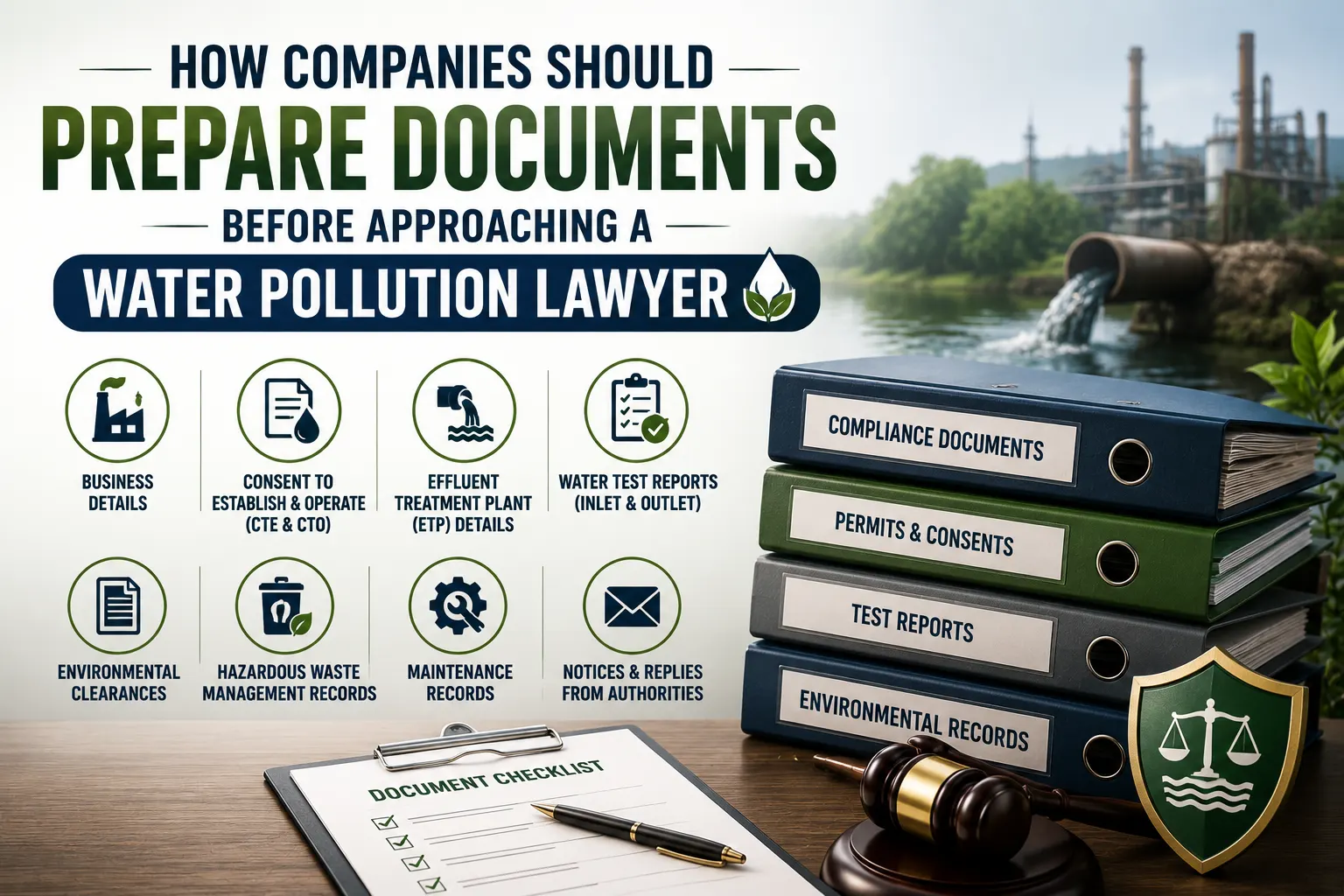
A water pollution matter can very rarely begin at a lawyers chamber. More often than not, it begins within the factory premises with a surprise notice; a midnight call from panic-stricken residents; an inspection report; an unsettling laboratory report; or just that small voice inside the management’s head that perhaps the compliance file is missing something. For a number of companies in India, there’s another factor. Pollution is one concern. A bigger concern is poor document organisation. “We have an ETP”, “we are running an STP”, “we have tied-up with a vendor for sewage management”, “we have our own disposal arrangements”, are all valid answers. Until the Pollution Control Board, DPCC, SPCB, CPCB, municipal authority, District Magistrate or NGT asks for the records. Then panic strikes. And the file isn’t complete. Preparing your documents and visiting a Water Pollution Lawyer is a two-step process. Before you meet a lawyer: Water pollution complaints are being taken more seriously these days across Delhi NCR, Noida, Ghaziabad, Gurugram, Faridabad, Meerut, Lucknow, Jaipur, Mumbai, Pune, Bengaluru, Hyderabad, Chennai, Kolkata and Ahmedabad. Industrial areas, business hubs, commercial complexes, hotels, hospitals, residential societies, warehouses, malls, building construction sites and manufacturing facilities are fast being monitored for water contamination since it affects public health, ground water level, household drains, city drains and ultimately community living. Action can be initiated because of untreated effluent found at the treatment plant gate, illegal discharge in a stormwater drain, STP or ETP failure, bypass of ETP units, dirty water runoff during rain, tanker disposal in storm drains, direct drain connection without treatment, hazardous waste residue found in soil or water, mishandling of waste treatment sludge, or even non-renewal of Consent to Operate past deadline. In some situations, the management only finds out about the action when they receive a notice from the local Pollution Control Board or NGT. Often companies lose precious time because documents are not compiled properly. Does your accounts team have the vendor invoices? Is plant staff maintaining logbooks? Does admin have all municipal papers? Is the compliance department storing consent copies? Is your director keeping old committee notices in his room? These are just some areas where important paper work is stored without the knowledge of others. Advocate BK Singh & Advocate Sadhna Singh know that when a Water Pollution Lawyer starts building a case, he needs all these documents compiled in one place to give you a reliable legal opinion. What does a Water Pollution Lawyer really need? Documents. He needs paperwork that clearly answers the following question: “What exactly happened, who had control over the activity happening, what permissions did we have and what proof do we have to showcase our compliance or corrective action?” It sounds simple, but in water pollution matters, the legal questions can relate to anything from industrial effluent treatment and discharge, building sewage systems and drain connections, stormwater drainage misuse, illegal pipeline connections to internal sampling failures and non-compliance with the conditions of consent. Divide assumptions from facts. Statements like, “Our plant follows all water pollution norms” or “Our discharge is compliant with quality standards” are simply assumptions. File must have hard proof of consent validity, installed treatment capacity, route of discharge, inlet & outlet laboratory values, daily operation logs, regular maintenance records and correspondence with authorities. A good document file also allows your lawyer to quickly determine whether you should deny the allegations against your company, or plainly admit a technical default, submit a rectification plan, request re-inspection, challenge excessive demands or file for dismissal in case NGT or some other authority has been misled. Indian water pollution matters generally revolve around The Water (Prevention and Control of Pollution) Act, 1974, The Environment (Protection) Act, 1986 and rules made there under. Courts also consider consent conditions as mentioned by SPCB or DPCC and direction(s) issued by the respective pollution control authority. If the matter involves environmental damage, restoration, compensation or directions against the authorities themselves; the National Green Tribunal Act, 2010 becomes relevant. Factories, offices and businesses should remember this: your legal risks are not limited to the act of discharging wastewater into drains or pipelines. Legal risks could arise from operating without valid consent, violating conditions of consent, not maintaining records as required by consent, ignoring PCB notices or ‘show cause’ notices, misreporting the treatment capacity of your installed ETP or lying about how you dispose treated waste/sludge. Matters can remain at the PCB level or move on to closure of activity directions, environmental compensation, prosecution, municipal fines or drains department action, disconnection of electricity / water supply, or NGT directed proceedings. It all depends on the facts, the authority writing to you, your location, the nature of your activity and documents you have to support your statement. If you are operating any kind of industry or commercial activity in Delhi NCR or any other major city in India, you should know that classification of your consent, category of your commercial activity, installed treatment system capacity, water consumption, water discharge standards, inspection history and consent renewal status will matter. A lawyer cannot evaluate your risk until you show him all these documents. A notice copy alone isn’t enough. Any company which consumes water, treats wastewater, stores chemicals, generates sludge, has an STP or ETP system or discharges waste water into a drain should ideally have a basic water pollution file ready. This includes Factories, Hotels, Restaurants, Hospitals, Laboratories, Housing Societies, Shopping Malls, Laundry units, Dyeing units, Packaging units, Food Processing units, Pharma units, Automobile Workshop units, Schools, Warehouses and Builders/Construction Companies. Real estate builders and Resident Welfare Associations also need to maintain proper records any time sewage treatment plants are mentioned, groundwater is pumped for construction purposes, water tanker supply is arranged, rainwater harvesting systems are installed or building construction stormwater is channelised through community drains. MSMEs think they can escape liability due to smaller operational size. Think again. BK Singh & Adv Sadhna Singh also tell young startup companies and entrepreneurs to assess their environmental documentation when leasing a new premise, shifting plant locations or installing new water-consuming machinery. Once a resident or authority complains, you will have to show the file instantly. A prepared and responsible company always looks better to authorities than an unprepared company who refuses to admit the violation. Organise your authority papers neatly. Consent to Establish, Consent to Operate, renewals, inspection samples and reports, show cause notices, closure orders, environmental compensation demands, previous replies sent to the authority and official emails should be put in date order. Highlight expired documents, pending permissions and documents being contested by the company. Technical records come next. This includes your ETP or STP layout with installed capacity, flow meter records if applicable, inlet & outlet test reports, lab analysis reports, daily operation and maintenance registers, chemical dosing charts if any, sludge disposal records, photographs of the facility and drain layout if applicable. The file should include water bills and tanker invoices too. Vendor contracts/agreements should be included. Lastly, prepare the ‘incident file’. If your company has received a notice,complaint or has been visited by an inspection team, note down the date, names of the inspecting officers, samples taken by the team, alleged violation, documents they asked for and the last date to reply to the notice. Save CCTV recordings if available, photographs of the plant/treatment plant and gate entry register, visitor’s register and internal team emails where applicable. Once documents are arranged, the management should prepare a 2-page factual note on what happened, in chronological order. DO NOT hide important default. You lawyer can handle a weak fact better than a hidden fact found later in your conversations with him. Note: A company should NOT prepare aged documents or update old files to suit their current situation. It may cost you your credibility as a truthful business. Take a safer route. Find out what documents you are missing, explain them honestly and bring proof of corrective action taken presently. BK Singh & Adv Sadhna Singh often find that companies who bring only favourable records to us, become weaker legally. That is because the department or authority already has the inspection material, photographs, sampling reports or resident complaints. Supplying only selected records to your lawyer weakens your legal position. As mentioned above, water pollution cases can get quicker orders. Your reply period for a show cause notice can be very short. Closure of business orders can demand an urgent representation. Environmental compensation demands require you to file a detailed factual and legal response. NGT matters demand quick filing of reply, affidavit, compliance report or objections to the order. Companies must prepare a date chart starting from when they first applied for permission until the latest notice received. Note down the dates on which consent was granted, renewals were applied for and granted, inspections took place, sampling was carried out, laboratory report was released, notices were received and replies were demanded. Note down rectification dates if any and dates of communication with authorities. Replying late will make you look non-serious about the matter. Replying in hurry without documents will get you into admissions. Take a balanced approach. Gather the record first. Ask the lawyer to identify legal issues. Once he gives you the legal route, prepare your facts. Civil suits involving PCB notices can take reference from our guide on how to reply to Pollution Control Board notices. Legal advice is still required on a case by case basis. Give just a look at the following mistakes. Every day companies who get summonses realize these five mistakes. There are many more yet these five things can destroy your case. Not paying attention to conserve records, failing to preserve CCTV recordings during sampling, mixing sewage treatment plant records with effluent treatment plant records or stormwater drains is also common. Some companies even blame vendors without contracts. Others blame neighbouring units without a drain map. Acting early saves time and cost. Advocate BK Singh & Advocate Sadhna Singh recommends taking legal advice at the first notice itself. We can guide you on how to preserve evidence, avoid defensive replies and sort out issues internally. Documenting simply means saving hard copies of ETP/STP compliance. Not doing so can attract undesirable inspector remarks during subsequent inspections, environmental compensation demands, closure of activity orders, prosecution risks, non-renewal of consent, project delays, reputation damage, third-party vendor litigations and complaints by residents/local authorities. NGT can suspend activity, disconnect utility services and order compensation. Water pollution complaints can affect daily operations for hotels, hospitals, factories and construction projects. Any closure order or social media complaint affects cash flow, employee satisfaction, customer support and lender agreements. Remember, pollution matters are evidence led. The law does NOT allow companies to simply say “We are compliant to all regulations”. You have to SHOW records to prove your compliance. Read more about how businesses should handle PCB and pollution related issues on NGTLawyers’ pollution control lawyers page. Companies must consult a lawyer as soon as a water pollution notice, show cause notice, sampling failure, environmental compensation demand, closure warning, resident complaint, municipal body complaint or NGT order is received. Even before beginning your manufacturing unit, water pollution lawyers can help you with compliance assessment, renewing permissions, lease or sale of an industrial unit, setting up new water equipment, changing your manufacturing process or outsourcing wastewater treatment to third-parties. You will thank yourself later. BK Singh & Adv Sadhna Singh can review your water pollution documents, prepare your replies to authorities, test your consent conditions, understand technical evidence, draft representations to authorities and deal with NGT related proceedings where necessary. We help companies make their file LEGALLY usable. We pay attention to details that are legal and practical. It includes identifying missing documents, deadlines for compliances, reviewing inspection documents, drafting affidavits, giving advice on remedial measures and guiding you to not making damaging admissions. Companies looking for extended environmental support can learn about our environmental lawyer for companies or read our NGT complaint online guide if the issue requires NGT proceedings to be filed against the company. You may directly visit NGTLawyers homepage to meet us and avail environmental lawyer consultation across India. A company should show consent paperwork, inspection reports, notices received, lab reports, ETP or STP records maintained, site photographs showing layout of drain or water treatment plant, drain layout if applicable, CCTV footage if available, water bills, tanker invoices and correspondence with authorities or vendors. A lawyer needs both technical and legal documents to understand the risks your company is facing. Yes, most businesses activities these days require valid Consent to Operate as per the pollution control laws relevant to your industry category & location. Consent conditions often outline what quality of discharge is allowed, what records need to be maintained and what standards you must adhere to while operating. Yes. We can review the notice, understand the allegations, deadlines given to you, examine supporting documents attached with the notice and prepare your reply or representation. The legal route depends on the consent conditions your company is operating under, facts of inspection, sampling findings and urgency of the matter. If your reply deadline is tomorrow and lab reports have not been received, request the laboratory to provide quick testing results. Ideally, DO NOT send a legal reply without confirming lab reports if your case centres around sampling allegations. If time is very less, send an interim reply along with a request to submit lab reports. The strategy differs case by case depending on the notice and documents with the company. Yes. They can help showcase your plant’s daily operation, installed treatment capacity, routine maintenance activity, chemicals being dosed, quantity of water being treated and what proactive steps were taken if non-compliance was found. Make sure they can be backed-up with lab reports, photographs of the treatment plant, tanker invoices and employees/staff on duty records. Environmental compensation demands can be challenged if the authority has calculated the demand incorrectly, asked for compensation beyond the scope of the order, if the order is based on assumptions, procedurally incorrect or you have evidence to rebut their claims. Documents again become important because no Environmental Court or Tribunal will hear your say-so without proving your claims with evidence. Sit with us when any notice, inspection report, closure warning, environmental compensation demand, resident complaint, municipal body complaint or NGT notices are received by the company. A lawyer can preserve evidence, advice what NOT to say in your first reply and correct the contents of your reply if required. We recommend acting sooner rather than later. Get all your vendor agreements/orders ready. Work orders, invoices, transport receipts, disposal certificates provided by the vendor, GPS traced photographs and email correspondence where applicable. Simply blaming a vendor without showing proof will not help. The company is still expected to exercise due diligence and ensure vendors are following mandated rules. If records are missing due to a genuine reason, they can be explained with recent testing done, fresh corrective action taken, affidavit from the owner or explaining technicai glitch with your engineer’s help. Do NOT try creating aged documents or backdate existing files. Tell your Water Pollution Lawyer the truth and he can guide you on how to rectify documentation mistakes. Ans. If your commercial or industrial activity consumes water, generates wastewater, deals with hazardous chemicals, operates machinery which uses water, falls under any consent category then yes. Startups and MSMEs delay compliance most often because they receive a notice or complaint first. Yes. NGT has dealt with substantial environmental disputes under The National Green Tribunal Act, 2010. If facts allow, NGT can ask the concerned authority to file a compliance report, analyse restoration carried out by your company and deals with compensation related issues. Every order depends on the evidence. We usually read the notice, understand the allegations, prepare a chronology of events based on consent conditions and documents your company carries. We then test the technical records and go slow on weak points. We draft a reply that is factually stable, legally cautious and supported by documents. Yes you should. CCTV recordings, gate entry register, photographs of the plant and visitor register can be used to prove activities carried out during inspection, sampling, tanker arrival, cleaning operations or illegal discharge (if it indeed happened). Remember, many CCTV systems overwrite old recordings. Preserve them ASAP. Yes. Your lawyer will build the legal strategy and draft legal documents. A technical consultant will help you with treatment plant layout, sampling procedures, clarifying technical information and getting your act compliant with regulations. The stronger your water pollution matter, the more you need both legal and technical expertise. We are based in Delhi NCR but our environmental lawyers and NGT lawyers take care of businesses and companies all over India. Advocate BK Singh & Advocate Sadhna Singh can help you with your documentation, replies to authorities, compliance checking and legal proceedings depending on the facts of your case and where your factory/office is located. Your company shouldn’t walk into a lawyer’s chamber panicked with just a copy of the notice. Walk in with a proper file, a date wise chronology, technical records, consent paperwork, site evidence and honest instructions. Water pollution legal battles are heavily dependent on documents because pollution affects the environment, common public and business operators. cology matters. Better documents allow your lawyer to quickly identify the safest legal route. Scarce documents creates panic, confusion and more time wasting. BK Singh & Adv Sadhna Singh can walk you through notices received from the pollution control board, how to reply to PCB notices, your existing compliance status, NGT related issues and water pollution documentation in offices. The sooner we assess your file, the sooner we can help you determine a legally-safe response. Disclaimer: This article is of general information only and should not be construed as legal advice for any specific company or legal dispute.Documents a Company Should Prepare Before Visiting a Water Pollution Lawyer
Build your file before consulting a lawyer
Seriousness in hubs like Delhi NCR
Why documents take time to find
Fast tips to help companies…
Documents a Lawyer wants to see FIRST
Indian law related to water pollution files
Factories? Hotels? Who needs a water pollution file?
Arranging files for better legal consultation
Documents Needed by Companies
Documents Needed What to Keep Ready Why It Helps Consent records CTE, CTO, renewals & applications, consent conditions These documents show the status of your legal permissions Technical records ETP/STP layout, installed capacity, flow meter records, operation and maintenance logs These records reflect your treatment capacity & daily operation details Testing proof Lab reports, field sampling records, inlet and outlet test values Real time testing documents shows where your water quality stands Disposal records Sludge treatment and disposal records, tanker invoices, hazardous waste/vendor invoices These speak about how you handle waste after treatment Authority papers Notices received, replies sent, inspection orders & reports, official email correspondence Documents which speak about the procedural history of your case Site evidence Site photographs, drain layout/map, CCTV recordings, GPS traced images Documents which tie your paperwork to real ground situation Corrective action initiated Repair bills, rectification memos sent to officers, fresh testing done What happened after you found about the issue Timeline companies should note BEFORE replying to notices
What mistakes can harm your water pollution case?
What happens if you dont have records?
Consult a lawyer before…
Can BK Singh & Adv Sadhna Singh help?
FAQs
1. What papers should I bring before meeting a lawyer?
2. Do I really need Consent to Operate for water pollution related matters?
3. Can BK Singh & Adv Sadhna Singh help me review a Pollution Control Board notice?
4. Should I reply to the notice if I am yet to collect the lab reports?
5. Are ETP and STP daily logbooks helpful?
6. Can environmental compensation be challenged?
7. When should we involve BK Singh & Adv Sadhna Singh?
8. What should I do if the pollution was caused by a vendor?
9. Can I get old records corrected later?
10. Do startups and small companies have to worry about water pollution compliance files?
11. Can NGT pass orders on water pollution matters?
12. How do BK Singh & Adv Sadhna Singh prepare my company’s FIRST response?
13. Should I preserve CCTV recordings after inspection?
14. Will I still need a technical consultant if I hire a lawyer?
15. Can BK Singh & Adv Sadhna Singh help companies located outside Delhi NCR?
Let your file speak for itself
There's no reason for concern. There is no difficult-to-understand legalese.
Someone who has helped many people with the same problems gives you clear, honest advice. We want to make the legal process easy to understand and use for everyone.
Schedule Your Consultation