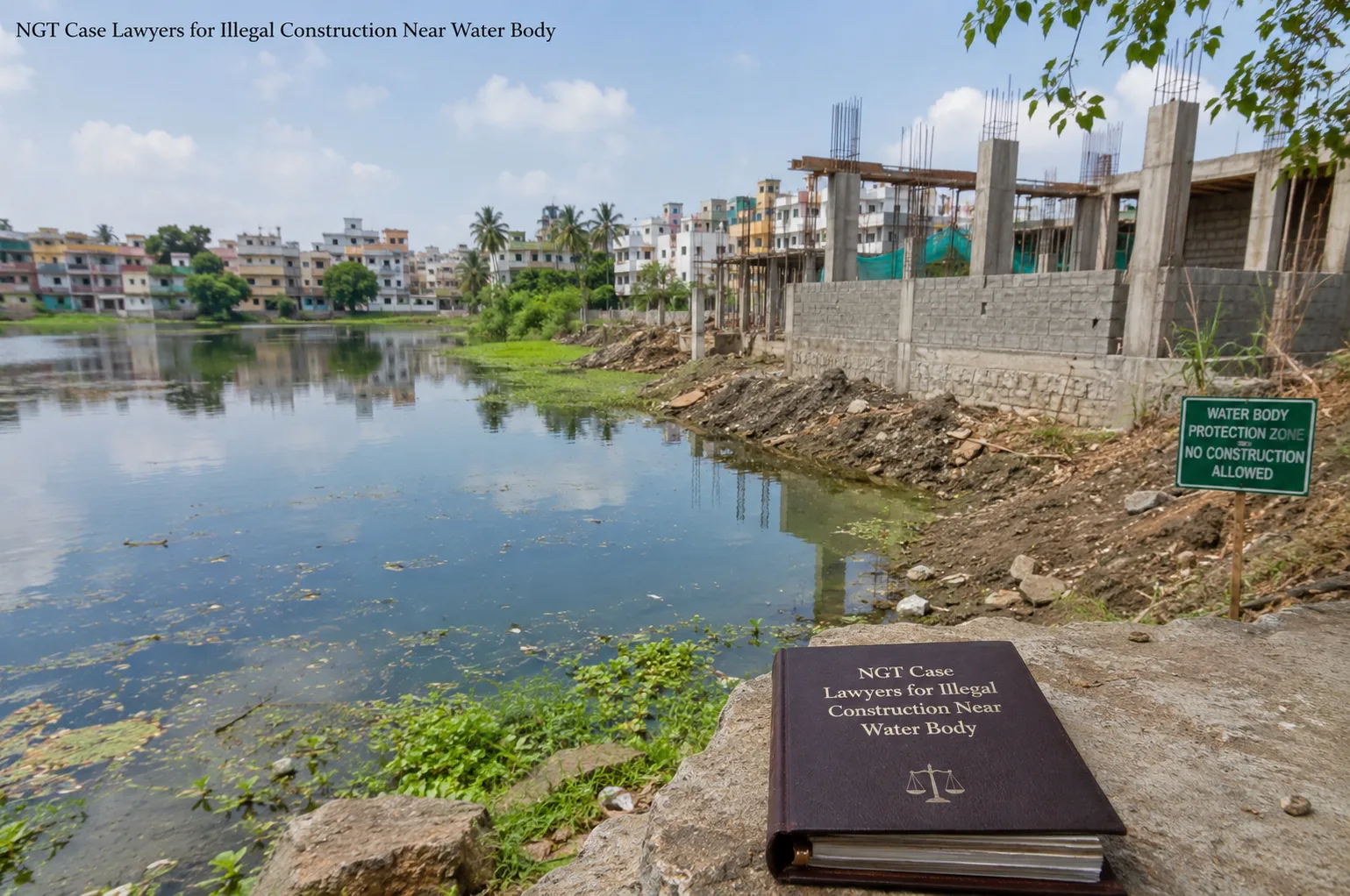
Illegal construction near pond, lake, river, drain, floodplain or wetland may start as a local dispute about building walls or lowering of ground. The next day the choked stormwater drain floods the road after light rain. Or sewage backs into homes. Or the village pond of twenty years disappears behind boundary walls. That is when citizens realise it is more than a local property matter. It is an environmental matter. NGT Case lawyers for Illegal Construction Near Water Body help common citizens, RWAs, landowners, builders, companies and public-interest groups understand whether the unauthorised construction near a water body creates an environmental issue serious enough to take to the National Green Tribunal. Illegal construction becomes an environmental matter if it encroaches a water body, obstructs natural drainage, dumps debris, destroys groundwater recharge, discharges untreated sewage, violates wetland norms or falls inside a restricted buffer zone. Many complainants start on the wrong foot. They casually complain to the local authority, hoping it will take action. By the time they hire a lawyer the building is finished, the contractor has disappeared, the records are not collected and “the matter is under inspection” by the lazy public official. Legal intervention works at a different stage. Citizens need to gather photographs, maps, revenue documents, municipal files, pollution proofs, water body identification and a simple timeline of how the filling, dumping or construction activity impacts the environment. Readers who want wider awareness on environmental litigation, other lawyers and regulatory advocacy can browse NGT Lawyers once to understand related practice areas. Advocate BK Singh often reminds clients: NGT matters are fought and lost on facts, purpose and proof, not heated words alone. Illegal construction matters because water bodies everywhere are not vacant land waiting to be occupied or built upon. They provide important ecological services. They soak up rainwater, recharge groundwater, carry stormwater, maintain ecology and prevent urban flooding. When they are filled up, narrowed or polluted, it affects more than one plot or one owner. Drain encroachments are common in Delhi NCR, Noida, Greater Noida, Ghaziabad, Gurugram and Faridabad. Rainwater drains are common in Mumbai, Pune, Bengaluru, Hyderabad, Chennai, Kolkata, Ahmedabad, Jaipur and Lucknow. The client’s concern is always legitimate. Stop construction? Can the authority be pushed to inspect? Can debris be cleared? Will the builder sue me back? Will this matter affect my land since it has a sanctioned building plan? Will the NGT notice see my house? What if the boundary drain is mapped differently in old records and new survey papers? Some of these questions can be answered badly or trigger harassment. All of them require professional legal handling. A straightforward municipal offence may go only before the local civic body or civil court or High Court. But an underlying environmental question connected to a listed environmental law may make the NGT option viable. Advocate BK Singh typically reviews this analysis first before deciding if the matter warrants filing, complaining, defending or pursuing compliance corrections. An NGT case about illegal construction near water body is an enforcement of civil rights relating to environment. It is not about who owns the land or enjoys possession. The Tribunal hears cases where environmental damage has occurred or is likely to occur due to the illegal construction inside a drain, lake bed, floodplain area or wetland. A water body includes a lake, pond, river stretch, wetland, natural drain, irrigation canal, floodplain, tank, johad, talab, catchment area and recharge well. Every state has its local description and revenue maps. First identify the water body correctly based on location and characteristics. Title, boundary wall or local building plan violation is often not an NGT matter. Violation of environment, ecology or natural drainage near a water body may become an NGT Case. If construction obstructs a drain, fills a pond, violates wetland regulations, discharges sewage or damages a floodplain it may affect the environment. Clients approach lawyers in anger. They are upset. That is fair. But an NGT petition must concentrate on environmental impact, aspects of environmental law, extent of affected area, responsible parties and relief requested. Facts of how construction became illegal, how it affected the water body and why immediate directions are required must be presented cleanly. The National Green Tribunal Act, 20 10 is the primary law. Section 14 details the Tribunal’s jurisdiction. It can entertain civil cases and proceedings where a substantial question relating to environment is involved. This includes enforcement of any legal right relating to environment where the question arises under any of the laws mentioned in Schedule I of the 20 10 Act. Section 15 mentions relief and compensation. Section 16 mentions statutory appeals in certain cases. Appeals against the orders of NGT lies with Supreme Court only as per section 22. Illegal construction near water body may invoke The Environment (Protection) Act, 1986. This statute empowers the Central Government to take measures for protecting and improving the environment, preventing environmental pollution, enforcing restrictions and prescribing standards relating to emissions or discharge of pollutants. In egregious cases the order may require closure of the industry, regulation of production process or discontinuation of supply of services by the competent authority. The Water (Prevention and Control of Pollution) Act, 1974 is also central if construction activity or occupation causes flow of sewage, discharge of trade effluent, dumping of debris or dust, contamination of streams, wells, drains or other source of water. State Pollution Control Boards, Pollution Control Committees and local bodies are required authorities in these matters. Other applicable laws and regulations include Wetlands (Conservation and Management) Rules, coastal regulation zone notifications, municipal acts, town planning rules, master plans, specific environment clearance conditions or consent conditions, solid waste management rules, construction and demolition waste management rules, groundwater regulations and state specific directions to protect lakes and ponds. This blog does not cover every applicable law and format because such lists can go on. However, lawyers and advocates on this site understand these laws. They have successfully represented and advised clients about NGT matters involving illegal construction near water bodies. The Tribunal does not act as a normal civil court issuing directions on private title disputes. It can suo moto call for reports, press statutory agencies to act, mandate restoration of degraded lands and order payment of environmental compensation if harm to public environmental is proved. Advocate BK Singh first tries to understand four questions: Is there a water body on record or ground? Does the construction affect it? Does the situation raise an environmental law issue? Is NGT the best forum compared to municipal, civil, writ or criminal legal paths? Everyone who spots a pond being filled overnight should take photographs. RWAs where drain water stagnates or homes get flooded should step forward. Farmers who lose water flow due to blocked outlets should object. Buyers buying flats in projects near a lake should care. Landowners served a notice for raising construction inside green zone deserve advice. Builders and contractors also require help. Sometimes they get a legal notice for illegal construction near water body despite local sanctions and permissions. Municipal approval from one authority is no defence if environmental constraints were violated. Ignorance is not a defence in NGT. Students, NGOs, citizen groups and public-interest individuals knock the NGT doors when pollution affects a larger population. But public interest litigation has its own fact requirements. A PIL petition filed merely on photos and suspicion may get dismissed if maps, site records and statutory violations are ignored. Companies buying land or investing in property should care during their own due diligence. Floodplains may offer high returns. Land beside lakes, drains, wetlands may tempt builders. But unseen environmental notifications can affect project construction, funding, resale and occupancy. Fact collection is step 1. Date all photographs, videos and WhatsApp locations. Take wide-angle photographs to show surroundings. Courts and Tribunals do not care about distance between bricks and machinery. They need to know about the entire environment. Step 2 is identification of the water body through public records. Helpful documents include revenue maps, khasra documents, municipal layout plans, map extracts from master plan, old village records, updated wetland records, Google earth or old and new satellite images, any drainage plans available online and finally complaints sent to authorities with their reply. Depending on your location readers in Delhi NCR or near Delhi Principal Bench may refer to the Principal Bench NGT Lawyer page for more Delhi-specific representations. Step 3 would be filing a compliant to concerned authority. The authority changes based on facts. It could be municipal corporation or town hall, district magistrate, state development authority, improvement trust, pollution control board, irrigation department, state wetlands authority, local forests department or village/local body. A complaint letter is not a rant on social media. It must mention the site, violation spotted and documents on record. It must politely request inspection or action. If the authority response is inadequate or environmental damage is immediate, a well drafted application can be filed before NGT under Section 14. Original applications are still considered in appropriate cases. Court can hear requests for interim directions to restrain further construction activity, secure the site chemically, order inspection, restrain dumping, protect flow of drains or command authorities to share factual and action taken report. Those looking for lawyers who file drafts digitally can visit our verified NGT e-filing page. The matter typically goes through the process of scrutiny, listing, issuance of notice, response from authorities or committees, receipt of reports, replies from affected parties, final rejoinder and orders. Committee or expert inspections and reports are decisive in many cases. If the committee report is adverse or incomplete the opposing party will need to file specific objections along with documents proving their argument. Verbal disagreements are easy to dismiss. Online complaint filing process is different. There is also a guide to NGT complaint online readers may access. Role of Advocate BK Singh and his teams begins by analysing disconnected facts and converting them into a legally prudent case theory with proper parties, reliefs and documents annexed. Illegal construction NGT cases need proof connecting the filling of debris with environment. Start a new folder. Do not wait for the lawyer to tell you to keep documents. Documents you should always try to collect include geo-tagged photographs, videos of surroundings, screenshots of location from Google maps, layout plans, building sanction documents from municipality, revenue map or khasra/khatauni, map extracts from master plan, wetland recognition records or India lake atlas documents, old and new satellite images from Google maps and official websites, any complaints sent to authorities with postal or courieracknowledgements, email exchanges, RTI replies exchanged between authorities, inspection report if any, notice from pollution control board or environment department, laboratory water test reports indicating pollution or sewage, certified drainage maps from municipalities or lakes departments. Project defending parties must carefully add building plans, environment clearance documents if any, consent certifications, photographs of site before construction, approved drainage plans showing gutters or stormwater drains built into development, rainwater harvesting certificate if given by CPCB or any photo documents showing waste disposal plans, contractor name and license details, other approved plans suggesting compliance care by builder or landowner. Do not photoshop photographs and falsely increase distances. Carelessness in one document reflects poorly on entire case argument. Environmental lawyers thrive on proof, accuracy and credibility. Timing is important for Illegal construction near water body cases. Once environment damage takes place it is harder to win. Floodplains filled for construction cannot be opened later except by strong NGT interventions requiring demolition of buildings too. Once the basement is dug, ground water recharge gets affected permanently. Limitation for filing original applications before NGT under Section 14 is tied to when the cause of action actually arises. Court has very limited powers to condone delay in filing such applications. Claims for relief and compensation under Section 15 have separate limitation guidelines. Appeals under Section 16 have their own timeline restrictions. Since limitation can be computed differently based on relief sought and facts, readers should not try to do it casually. Suitable window to decide starts when earth movers arrive on site, debris is seen reaching the drain body, water flow gets visibly obstructed or sewage discharge starts into the water body. This means you should immediately call a lawyer and see if you should file a compliant, push for inspection, file something before NGT or choose a different legal avenue. Delhi NCR matters need faster movement because district magistrate, NGT Principal Bench and pollution control board all become relevant authorities. Readers living in Delhi may read about Delhi NGT lawyers for better city-specific context. Illegal construction complaints and filings do not guarantee the construction will stop. But not filing lets bigger damage happen. If a complainant watches the spot turn into concrete, proving damage will become harder. If a project owner ignores a notice from pollution board, municipal body or NGT and does not reply they will likely face inspection, adverse inspection report, restrain on construction direction, or orders to pay environmental compensation or restore the site. Neighbours and communities face bigger damage. Drain filled near your home will flood during rain. Pond filled becomes loss of groundwater recharge potential. Debris thrown in lake will affect birds and fish. Sewage diverted into floodplain affects smell, insects, flies and daily quality of life. Property value dips too when a construction is caught in NGT proceedings or has demolition notices from courts. Buyers run, banks ask tough questions, lenders sense risk, tenants balk. Hiring a lawyer does not guarantee your case will win. What it does is practical. It helps preserve evidence, preserve important timelines and prevent careless mistakes from becoming costly. Lawyers must be consulted when construction activity starts near a water body and your own facts indicate likely environmental damage. Do not wait till the top floor is ready. Consult us if debris is coming towards a nearby pond, drain water from building is choked, dumping of debris is noticed near a river or floodplain, sewage flow is seen entering natural water body, construction is seen taking place deep inside the buffer area of a lake, your purchase project does not have visible environmental safeguards and yet the local authority is refusing to inspect despite complaints. Builders and owners must consult early if they receive notice from pollution board, building or municipal authority, state wetlands officer, state revenue office and even NGT itself. Responses sent casually become part of the record. They can be tortured against you later. Advocate BK Singh will first review if NGT application is needed or counselling with authorities, sending replies to notices or inspection requests or pursuing another legal course is appropriate. Often this first legal review stops clients from filing the wrong application. NGTLawyers.com can help citizens, RWAs and builders with illegal construction complaints, drain encroachment cases, debris dumping, sewage obstruction, regulatory defences, NGT proceedings, wetland violations, environment compensation matters, authority inaction or filing replies to directives or orders. Panic mongering is not done on this site. Our lawyers can help review documents you collected, assist with legal site inspection and evidence collection, draft competent complaints before authorities or NGT petitions, file for urgent relief to save water body from immediate damage, file replies to authority notices, file objections to unfair committee inspection reports, plan restoration or compliance and represent matters before the right forum or authority. Here is what we mean by that. Advocate BK Singh analyses cases at a practical level. No media drama. No exaggerated presentations. He and his teams focus on drafting, forum selection and documents. What this means for citizens and RWAs is that your complaint doesn’t get lost as a casual paperwork. Builders and individuals own unsolicited representations mean you have someone reviewing your plan to correct the violation, defend your case professionally or help respond before the matter escalates into larger troubles. They analyse if illegal construction near pond, lake, floodplain, drain or wetland raises a substantial question relating to environment. They guide citizens to collect evidence, identify authorities, file complaints or NGT applications and request interim relief from the Tribunal. They also handle cases where builders receive legal notices from NGT or other authorities. Yes. NGT can pass appropriate environmental relief if the case involves violation of ecology, encroachment, pollution of drains/lakes/water bodies or affects environmental rights. Relief can include restraint orders, onsite inspections, demolition, restoration, environmental compensation, debris clearance or action by statutory authorities. No. Local building plan violations may fall only before municipal authorities, civil courts or High Court. NGT will entertain cases that involve environmental damage or enforcement of a legal right relating to environment. See the Documents Checklist section above. Take ample photos and videos, gather maps, obtain revenue documents and water body proof. Strong cases have clean evidence. Yes. An RWA where residents suffer environmental damage like flooding, drainage obstruction, sewage discharge or disappearance of water body can file a petition before NGT. Collective damage and proper evidence must be mentioned. Yes. Builders or project owners can oppose NGT complaints by showing they have clear approvals, complied with safeguards, buildings don’t affect land status or water body, no environmental damage is caused or occurring and debris is being cleared/restoration plans are underway. Orders for restoration of degraded land or clearance of debris may be issued or directed by NGT if proof establishes damage to public environment due to illegal activity. Exact relief depends on facts, role of authority, statutory violations and environmental damage caused. Complaints to concerned authority showing you tried to get them to act is good evidence before NGT. But in urgent or serious cases court can still hear you directly after reviewing facts. Immediately when violations start. As soon as debris is noticed entering the drain body, buildings start coming up in floor sequences or ground excavation happens inside a floodplain area. Quick application means better chance of interim relief and directions. Evidence quality is crucial. Clients reach Advocate BK Singh for a careful review of facts before rushing to NGT. He will help identify the right forum, prepare complaint to authorities or NGT drafting and decide if urgent relief before NGT itself is viable. Each case is different. Free initial analysis is used to understand if NGT filing or any legal proceeding is needed. NGT Case lawyers for Illegal Construction Near Water Body is something every Indian city needs because when drain water bodies are destroyed or damaged it affects everyone. It affects roads which flood, homes which have sewage enter toilets, farmers who receive less water and buyers who purchased plot near a stormwater drain because it was cheap. Good cases are filed fast with strong evidence at the right forum. Weak cases fail even if the cause is genuine. You have legitimate concerns about environment and want action against builders. Build your case cleanly. Documents should speak louder than emotions. Watch construction activity near your drain body, submit click evidence quietly to authorities before abuse starts and contact us to know if NGT is the right option or counselling with building authorities is possible. NGTLawyers.com started to help Indians face pollution crimes, fly ash damage, NGT notices and unfair environmental objections. Advocate BK Singh can legally review your case right now. Tell us about illegal construction near a water body affecting you. We respond within hours to most requests. This article is intended for informational purposes only. It does not and should not replace professional legal advice.NGT Case lawyers for Illegal Construction Near Water Body
Why NGT Case lawyers for Illegal Construction Near Water Body Matter in India in 2026
QUICK FACTS BOX
Understanding the Core Legal Issue
The Legal Framework
Who Needs This Guidance?
STEP-BY-STEP PROCESS
DOCUMENTS AND EVIDENCE CHECKLIST
TIMELINES, PRACTICAL DELAYS AND DECISION WINDOWS
COMMON MISTAKES PEOPLE MAKE
RISKS OF IGNORING THE MATTER
WHEN TO CONSULT A LAWYER
HOW NGTLAWYERS.COM CAN HELP
FREQUENTLY ASKED QUESTIONS
1. What do NGT Case lawyers for Illegal Construction Near Water Body do?
2. Can NGT stop illegal construction near water body?
3. Is every illegal building matter suitable for NGT?
4. What proof we should gather before filing NGT case?
5. Can an RWA file NGT case against builder or building?
6. Can a builder fight an NGT case against his project?
7. Can NGT issue demolition orders?
8. Should I file a complaint to authorities before NGT?
9. How quickly should I act against illegal construction near water body?
10. How can Advocate BK Singh help me in this matter?
Final Thoughts
DO YOU NEED HELP?
Disclaimer
Table of Contents
There's no reason for concern. There is no difficult-to-understand legalese.
Someone who has helped many people with the same problems gives you clear, honest advice. We want to make the legal process easy to understand and use for everyone.
Schedule Your Consultation