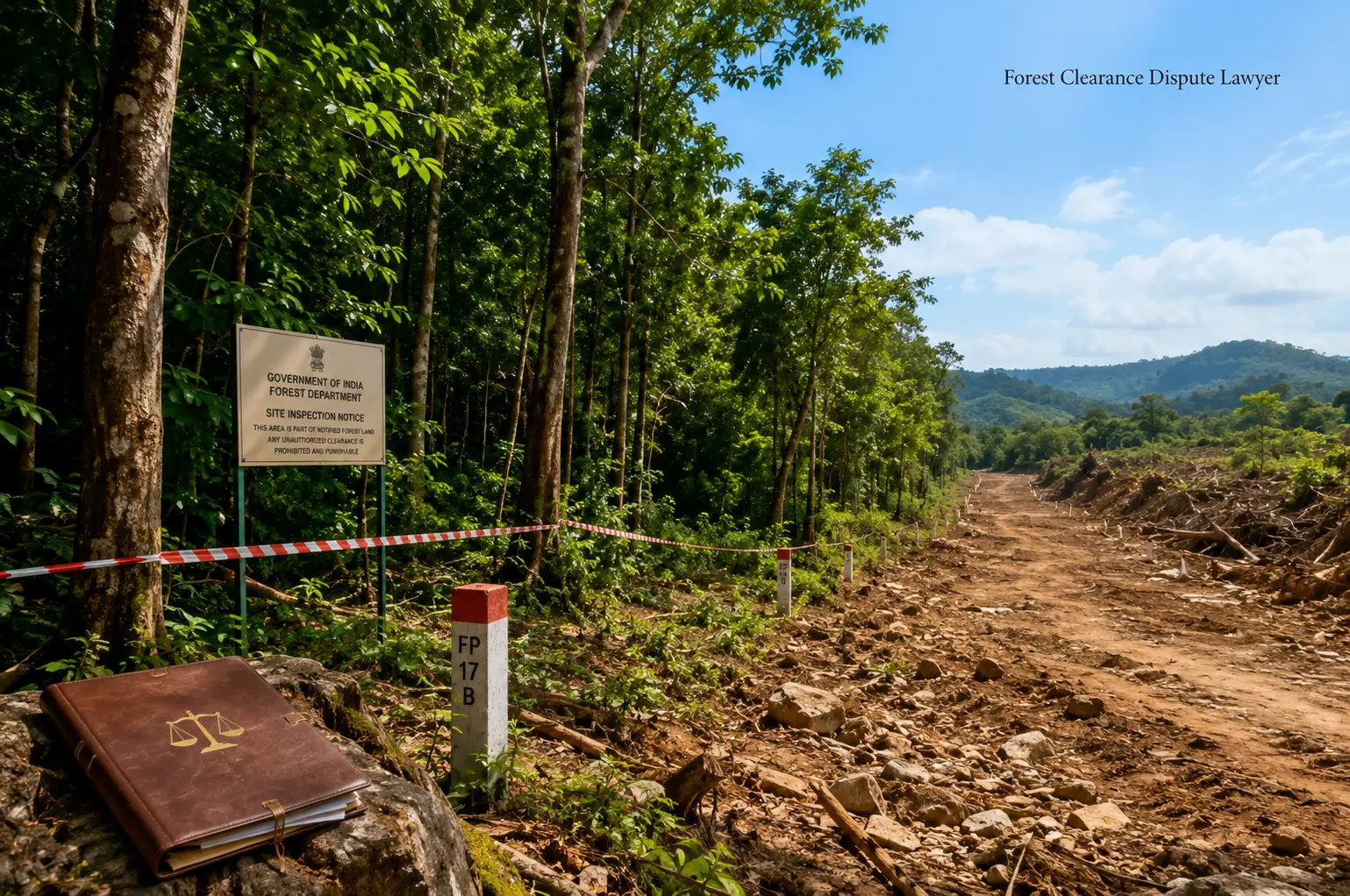
A Forest Clearance Dispute Lawyer helps citizens, property owners, businesses, RWAs, NGOs, contractors and project authorities understand whether forest approval was required, whether approval was correctly processed, whether clearance conditions are being violated, and which legal route may be available before the appropriate authority, tribunal or court. Ask anyone who understands forests how a forest clearance dispute begins. One day a road is widened along a green belt. Mining or industrial activity starts somewhere and villagers believe the forest record has not been respected. Someone says the land is not forest land. Someone else produces old records, points to trees that were cleared, or shows ecological disturbance at the site. In the beginning, forest clearance disputes may look technical. They may even appear to be only paperwork. They become urgent when work is stopped, trees are cut, a notice is issued, or a matter reaches the National Green Tribunal. A Forest Clearance Dispute Lawyer helps people understand whether the activity affects forest land, whether non-forest use required prior approval, whether clearance conditions were violated, and whether the correct legal forum is an authority, the NGT, the High Court or another competent forum. It is not only deep forests that create forest clearance issues in India. As cities and towns expand in Delhi NCR, Noida, Greater Noida, Gurugram, Faridabad, Ghaziabad, Jaipur, Mumbai, Pune, Bengaluru, Hyderabad, Chennai, Kolkata, Ahmedabad and other urban growth corridors, infrastructure projects, real estate, industry, mining, transmission lines, roads and public works often encounter forest records, old tree-covered land, ridge areas, green belts and ecological restrictions. When people approach Advocate BK Singh with forest clearance issues, they often come after work has already been stopped, a notice has arrived, or someone has filed an NGT matter. Shortcuts taken at the start can make the case harder later. Forest clearance issues are not routine. They can affect project viability, public interest, ecology, investment, compliance exposure, personal liability and community rights. BK Singh focuses on environmental issues and NGT matters at NGT Lawyers. His work is based on careful review of law, site facts, government records, project documents and regulatory compliance before taking the next legal step. Forest clearance matters continue to matter because a clearance usually means that money has already been spent on a project. A legally weak clearance can stop a project. A wrongly ignored violation can also allow serious forest and ecological damage to continue. Since 2021, development pressure has increased around forest and ecology-sensitive areas. Online clearance tracking through PARIVESH has made many forest clearance, environmental clearance, wildlife clearance and CRZ related proposals more visible. Citizens now ask questions when approvals affect trees near their homes, recharge grounds, groundwater levels, wildlife movement corridors, ridge land, urban forests or local living conditions. Consider issues around Delhi NCR alone: ridge areas, Aravalli violations, urban forests, green belts, notified institutional land, drains, roads, tree corridors and construction activities that may conflict with records or ecological restrictions. Similar disputes arise in Mumbai, Pune, Chennai, Kolkata, hill areas, mining belts and infrastructure corridors where roads, buildings, mines or public projects interact with forest land or ecological conditions. Businesses want clarity. They do not start projects to face legal stoppage. They may have finance tied up, contractors waiting, permissions they believe have been obtained and deadlines to meet. One mistake on the forest clearance side can lead to work stoppage, environmental compensation, prosecution risk, cancellation of approval or project delay. For local citizens or communities, this issue is personal. Trees do not return quickly. Dust and heat may increase. Flooding may become worse. Landslide risks may appear. Wildlife movement may be disturbed. If the affected area supported community resources or local ecology, everyone can suffer. A Forest Clearance Dispute Lawyer has to read more documents than many people expect. Revenue records, forest maps, approval letters, compensatory afforestation records, EIA or EC submissions where applicable, previous inspection reports, environmental clearance files, wildlife permissions, committee minutes, site photographs, satellite images and project drawings may all become relevant. Forest cases are evidence-led legal cases. They are not merely complaints that require drafting. Advocate BK Singh approaches these matters by connecting site facts with documents, law and the correct legal forum. Forest clearance generally relates to diversion or use of forest land for non-forest purposes, subject to the applicable legal framework and project facts. Prior approval of the Central Government is central to many forest diversion matters under Section 2 of the Van (Sanrakshan Evam Samvardhan) Adhiniyam, 1980. The National Green Tribunal may hear substantial environmental questions, compensation claims and statutory appeals where the matter falls within the NGT Act. PARIVESH is used for online submission and tracking of forest clearance, environmental clearance, wildlife clearance and CRZ approval proposals, where applicable. Delay can damage forest cases. It may weaken objections, affect limitation, reduce the possibility of interim relief and make evidence less credible. Strong forest matters usually depend on maps, records, photographs, inspection material and clear legal grounds. A forest clearance dispute usually asks a legal question about land, activity and permission. Is the land forest land or treated as forest land in law or government records? Is the proposed activity a non-forest use? Was the required approval obtained before the activity started? Were clearance conditions followed after approval? The core issue may look simple, but forest cases are layered. The answer may depend on revenue records, forest department records, old notifications, Supreme Court directions, project maps, site conditions, clearance letters and post-approval compliance. Clients usually come in two situations. Some want to challenge an illegal or faulty clearance. Others have received a notice, inspection communication or work stoppage direction and want help defending a project. Both situations begin with a disciplined study of facts and documents. Forest matters do not turn on advocacy alone. Document work is essential. Proving ground reality requires connecting maps, approvals, site photos, authority records and legal provisions. Advocacy without documents rarely succeeds in environmental law. For people focused on forest and wildlife concerns, see the Forest & Wildlife Lawyers service page for a focused introduction to that subject. Indian forest clearance law generally revolves around control on diversion of forest land for non-forest purposes, prevention of unauthorised forest damage, project-specific environmental permissions and judicial or tribunal oversight in appropriate cases. The correct legal forum depends on what exactly is being challenged or defended. The issue may involve a forest clearance order, violation of clearance conditions, compliance notice, rejection order, inspection report, stop-work direction, authority communication or a related environmental decision. The central statute at the heart of many forest diversion matters is the Van (Sanrakshan Evam Samvardhan) Adhiniyam, 1980. It was earlier known as the Forest (Conservation) Act, 1980. Section 2 is especially important. It restricts de-reservation of forests and use of forest land for non-forest purposes without prior approval of the Central Government. The 2023 amendment changed important parts of the law, including the title and applicability framework. Applicability must now be reviewed carefully with Section 1A, Section 2 and the applicable rules. State Government or UT authorities may examine, recommend and process proposals through the appropriate channels, but forest diversion approval under Section 2 is centred on prior approval of the Central Government. The exact route may involve forest officers, nodal officers, regional offices, advisory bodies, committees and Ministry-level scrutiny depending on project facts. State forest laws, tree preservation laws, local forest rules, ridge notifications, protected area restrictions, compensatory afforestation requirements and project-specific conditions may also apply. MoEF&CC approval does not automatically remove all state-level restrictions or local compliance duties. The Van (Sanrakshan Evam Samvardhan) Rules, 2023 and government guidelines help regulate proposal formats, scrutiny, compensatory afforestation, site inspection, compliance, exemptions and approval conditions. In practice, forest clearance files may move through the user agency, State Forest Department, Divisional Forest Officer, nodal officer, regional office, expert bodies and Ministry channels depending on the project. Some projects may also require environmental clearance, wildlife clearance, CRZ clearance, consent to establish, consent to operate or other permissions depending on project category, size, location and applicable law. Forest clearance and environmental clearance are different legal issues, but they may overlap in the same project. If your matter also involves environmental clearance, you may read the NGT EC Lawyer guide for related context. The National Green Tribunal Act, 2010 contains provisions relevant to forest and environmental matters. Section 14 deals with substantial questions relating to environment. Section 15 deals with relief, compensation and restitution. Section 16 deals with specified statutory appeals. Section 22 provides for appeals from NGT orders to the Supreme Court. In suitable matters, constitutional remedies before the High Court or Supreme Court may also be considered, especially where the dispute, remedy or authority action does not fit the NGT route. The correct forum should be chosen only after reviewing the exact order, cause of action, limitation, parties and documents. BK Singh reviews legal options before drafting documents. The wrong forum can waste months. An Original Application, statutory appeal, representation, legal notice, compliance reply, writ petition and Supreme Court appeal are not interchangeable. For wider tribunal-related assistance, see NGT & Tribunal Lawyers. Forest clearance disputes should begin with facts, not emotional assumptions. A complaint without records may fail. A project defence without approval documents may also fail. The following is a high-level legal route only, not a complete procedural checklist. The first step is to identify the land, project name, location, khasra details, map references, forest division, activity complained of and visible site condition. The issue may involve tree cutting, construction, mining, road work, transmission lines, boundary dispute, ridge area, green belt or recorded forest land. Forest clearance proposals may be traceable through PARIVESH where applicable. Approval status, proposal number, in-principle approval, final approval, compliance condition, inspection record and rejection communication can become important documents. A case may involve no approval, wrong categorisation of forest land, suppressed records, forged or outdated documents, breach of conditions, lack of prior approval, defective compensatory afforestation, violation of wildlife conditions, or incorrect stoppage of lawful activity. Depending on facts, the route may include a representation to the Forest Department or MoEF&CC, a compliance reply, a statutory appeal, an Original Application before NGT, an application for relief or compensation, or a writ petition before the appropriate constitutional court. Business projects defend forest matters differently from citizens or NGOs filing environmental cases. Every reply to a forest clearance notice can become evidence in later proceedings. A careful response should be based on records, approvals, maps and actual site material. Do not treat a forest clearance dispute as a routine complaint. The legal route should be decided after reviewing documents, limitation, authority action, project facts and site evidence. Documents decide forest cases. Before filing, replying or challenging any action, organise the available records. Evidence should be dated, relevant and connected to the legal issue. Do not guess the forum. Check official orders, notifications, clearance letters, PARIVESH records and authority records before deciding whether to file, reply or challenge. Forest cases have limitation periods. If you are late, your NGT case or appeal may fail at the threshold. If you are defending a notice and delay your reply, authorities may treat the response as weak or unreasonable. Limitation must be calculated separately in every matter. The date may depend on when the cause of action first arose, when the order was communicated, when the project activity started, when approval was uploaded, when notice was served or when a representation was rejected. Original Applications under Section 14 generally have to be filed within six months from the date when the cause of action first arose, with a limited condonation window of sixty days. Relief, compensation and restitution claims under Section 15 generally carry a longer limitation structure, but delay must still be assessed carefully. Statutory appeals under Section 16 generally have shorter timelines and are linked to the communication of the relevant order, decision, direction or determination. Appeals from NGT orders to the Supreme Court are also time-bound and must be assessed from the date of communication of the NGT order. Clients often say they discovered the issue late. That does not automatically save limitation. If work started months ago, approval was uploaded online, a department notice was served, or a representation was rejected earlier, limitation may be counted from those acts. Suitable forest matters may also require urgent interim relief to prevent irreversible site changes. Whether such relief is available depends on maintainability, limitation, urgency, evidence and balance of convenience. Advocate BK Singh recommends that clients focus on record-keeping so that law can work on their side. A strong case is built with evidence, not only emotion. For project proponents, ignoring forest clearance issues can create serious consequences such as work stoppage, suspension, prosecution risk, restoration directions, environmental compensation, cancellation of clearance, investor concern, delay in construction and reputational damage. For local citizens, ignoring forest violations can lead to irreversible ecological loss, tree loss, heat increase, dust, flooding, wildlife disturbance, loss of community resources and long-term damage to local living conditions. For everyone involved, ignoring orders of courts, tribunals or authorities can create contempt risk or additional adverse findings. Forest status issues can also affect sale, development and enjoyment of land until the legal position is clarified. Consult a lawyer as soon as you suspect a forest clearance status issue, NGT notice, tree-felling activity near forest land, compliance breach, stop-work order or ecological violation affecting you. Lawyers may not be able to help effectively if you wait until the site is destroyed, trees are already cut, or limitation has expired. Civil litigation and NGT timelines are strict about delay. Businesses may consult a lawyer before buying land close to forest areas, Aravalli land, ridge areas, boundary disputes, green belts or projects based only on oral assurances. Citizens and NGOs may consult a lawyer when notices are ignored, tree-felling begins, or specific evidence supports a forest violation allegation. Advocate BK Singh can review facts and help you decide whether a representation, legal notice, compliance reply, statutory appeal, NGT application or writ petition is appropriate. For profile and practice details, you may visit Advocate BK Singh. A forest clearance matter involves local records, old government files, project approvals, site material, maps and legal strategy. Forest cases are document-driven. Facts and visuals matter. NGT Lawyers can assist with reviewing documents, identifying the correct forum, preparing legal notices or compliance replies, assessing NGT filing options, challenging faulty approvals, defending project notices and guiding clients through authority-level representation. Litigation helps affected communities and residents when documents prove concerns, the correct forum is chosen, and filings show past violations, present harm and forward-looking relief. The same discipline applies to defending projects or responding to compliance notices. No lawyer can guarantee forest clearance results. Matter-specific facts, law, records, evidence and document discipline guide outcomes in environmental cases. What can be ensured is that documents are reviewed properly before being placed before the appropriate forum on time. For Delhi-specific assistance, see Environmental Lawyer for Forest Clearance Issue in Delhi. A Forest Clearance Dispute Lawyer assists with reviewing forest records, clearance documents, notices, site evidence, authority communications and legal remedies. The lawyer may help decide whether the matter requires a representation, compliance reply, statutory appeal, NGT filing or another legal route. Yes, a forest clearance-related order or decision may be challenged before the NGT where the matter falls within the NGT Act. In some cases, the remedy may be a statutory appeal. In other cases, an Original Application may be considered if the dispute raises a substantial environmental question arising from a scheduled enactment. The correct remedy depends on the exact order, cause of action, limitation and documents. No. Every project near trees does not automatically require forest clearance. The answer depends on whether the land is forest land, deemed forest, recorded forest, protected area, ridge area or otherwise restricted, and whether the activity qualifies as non-forest use under applicable law. PARIVESH helps in online submission and tracking of forest clearance, environmental clearance, wildlife clearance and CRZ approval proposals, where applicable. It can help identify proposal status, approval documents, file numbers and public information available for a project. Yes, but the response should be careful and document-based. Helpful material may include land records, approved drawings, clearance letters, authority correspondence, condition-wise compliance, site photos and any other proof supporting lawful activity. Timelines depend on the remedy. NGT Original Applications, compensation claims, statutory appeals and Supreme Court appeals follow different limitation rules. Limitation must be calculated from the correct date based on the order, cause of action, communication, approval upload, site activity or rejection. Consult a lawyer when you suspect forest clearance irregularity, receive a notice, see tree-felling activity near restricted land, face a stop-work direction, or need to verify project compliance before investment, construction or filing. Forest disputes do not appear suddenly. Someone may have used forest land for non-forest purposes without proper approval. Someone may have ignored clearance conditions. Someone else may have been wrongly stopped from lawful work. If parties understand their rights and responsibilities early, many disputes can be avoided. The bottom line is simple. Gather documents before reacting. Save your fight for the correct authority, tribunal or court. Businesses should review forest clearance history before buying land, starting projects or cutting trees. Citizens should preserve early objections, photographs, maps and records before approaching authorities. Authorities and public officers should preserve records carefully. If citizens send early protest letters, those objections should be retained with work orders and project files. If permission was granted and conditions are later violated, corrective legal action should follow. A Forest Clearance Dispute Lawyer can help sort lawful activity from unlawful forest damage. The next action depends on facts. Advocacy is built on evidence. A lawyer who studies documents before drafting can reduce delay, improve clarity and help the client choose the right legal route. This blog is prepared for general information purposes only. It should not be treated as legal opinion for any specific forest clearance matter. Forest clearance disputes are fact-specific and should be reviewed with documents, site records, limitation and applicable law before any legal step is taken. Advocate BK Singh is an Indian environmental lawyer specialising in NGT work. His law practice covers forest clearance law, environmental clearance law, pollution disputes, industrial compliance notices, NGT applications and appeals for citizens, RWAs, NGOs, companies and project authorities in India. Based on document review and effective legal drafting, he guides clients through forest violation, compliance, representation and defensive litigation by reviewing laws, authority records, project site material and maps before suggesting the appropriate legal remedy. Forest Clearance Dispute Lawyer
Introduction
Why This Issue Matters in India in 2026
Quick Facts
Forest Diversion
Prior Approval
NGT Remedy
PARIVESH
Understanding the Core Legal Issue
What Legal Framework Applies to a Forest Clearance Dispute?
Central Law
State Laws and Local Restrictions
Guidelines, Rules and Departmental Process
Environmental Clearance and Connected Permissions
NGT and Judicial Review
Who Needs This Guidance?
Broad Practical Route in a Forest Clearance Dispute
1. Identify the Land, Project and Activity
2. Check Approval Status
3. Identify the Legal Defect or Defence
4. Choose the Correct Legal Route
5. Respond Carefully to Notices
Documents and Evidence Checklist
Document / Evidence Why It Matters Land records, khasra details, revenue maps and forest maps Help establish whether the land is recorded, treated or claimed as forest land or otherwise restricted. Forest clearance file, in-principle approval and final approval Shows whether approval was granted and what conditions were imposed. PARIVESH proposal number, application number and status Helps understand whether the proposal is pending, approved, rejected or under compliance review. Site photographs and videos Show visible work, tree cutting, ground condition, damage, boundary markings and activity on site. Satellite images, geo-tagged photos and Google imagery May support change-in-use, timeline, vegetation cover and site alteration arguments. Inspection reports, DFO notes and authority correspondence Provide official facts and departmental history of the dispute. Environmental clearance, wildlife clearance, CRZ clearance or consent records Show whether connected permissions overlap with the forest dispute. Public notice, objections and representations Help show early protest, knowledge of dispute and community participation. Site drawings, village layout, alignment plan and project drawings Help compare approved activity with actual ground activity. Expert opinion or ecological report Technical material may support environmental impact, forest damage or compliance arguments. Timelines, Practical Delays and Limitation
Section 14 NGT
Section 15 NGT
Section 16 NGT
Section 22 NGT
What Mistakes Do People Make in Forest Clearance Disputes?
Risks of Ignoring the Matter
When Should You Consult a Lawyer?
How ngtlawyers.com Can Help
Frequently Asked Questions
What does a Forest Clearance Dispute Lawyer do?
Can forest clearance be challenged before NGT?
Is forest clearance needed for every project near trees?
What is the role of PARIVESH in forest clearance cases?
Can a company defend itself after receiving a forest violation notice?
What are the timelines for filing a forest clearance case?
When should you consult a lawyer for forest clearance issues?
Final Thoughts
Disclaimer
Author Bio
There's no reason for concern. There is no difficult-to-understand legalese.
Someone who has helped many people with the same problems gives you clear, honest advice. We want to make the legal process easy to understand and use for everyone.
Schedule Your Consultation