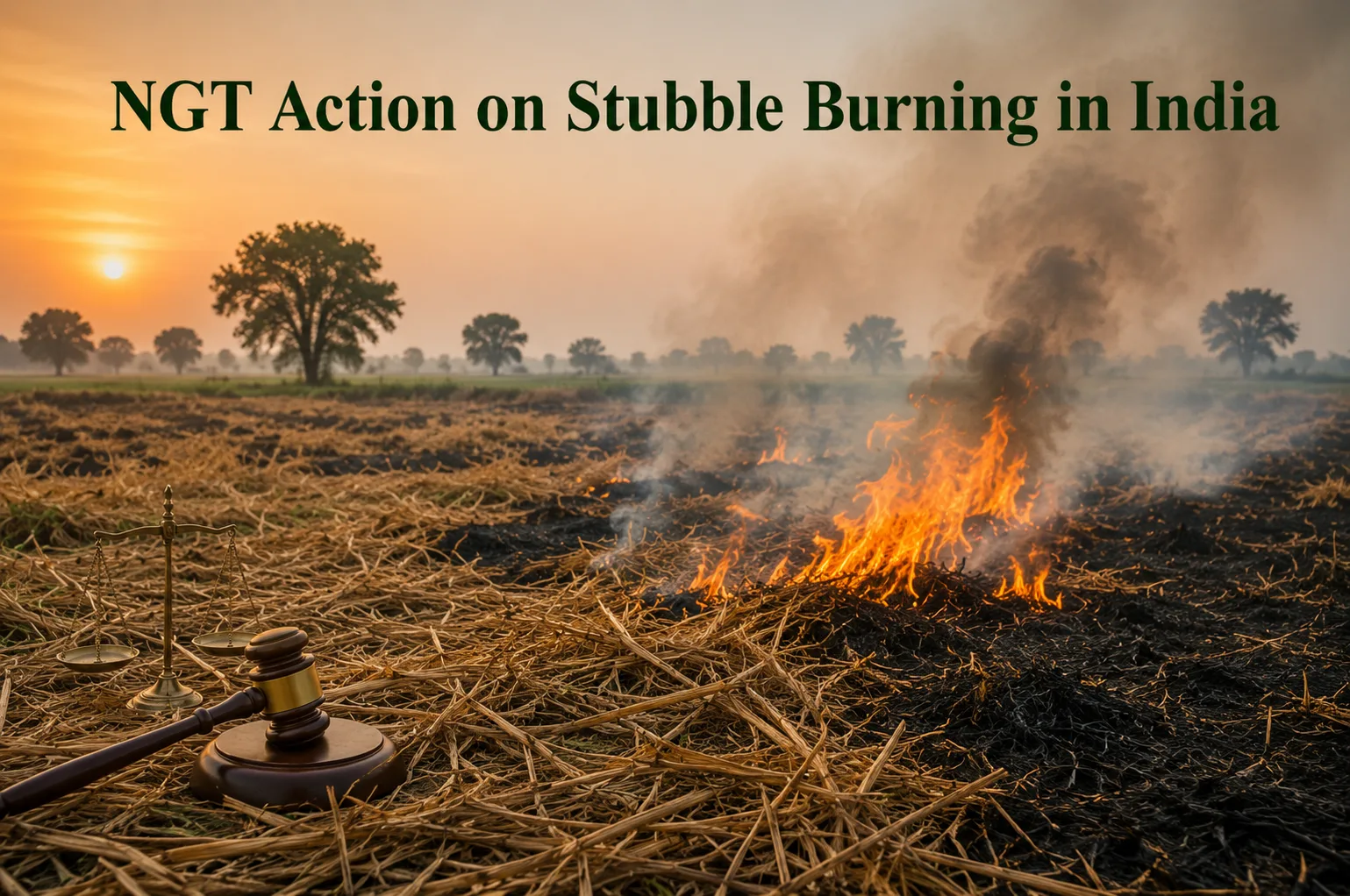
A clear legal guide on stubble burning, NGT directions, crop residue burning penalties, Pollution Control Board action, farmer notices and citizen complaints in India. NGT Action on Stubble Burning in India is not just about blaming farmers or issuing penalties after a field fire is noticed. It is about controlling a recurring pollution pattern that affects air quality, public health, soil quality, road visibility and the larger right to a clean environment. Every winter, especially around the paddy harvesting season, the same question comes back: why does Delhi NCR air pollution suddenly become so severe? Stubble burning is not the only reason, but it has repeatedly been treated as one of the serious contributors in North India. In simple words, stubble burning means burning the leftover crop residue in the field after harvesting. It is commonly linked with paddy straw, but crop residue burning is not limited to paddy alone. Farmers often do it because it is fast, cheap and clears the field for the next sowing cycle. The problem is that the smoke does not stay inside one village or one farm. It travels, mixes with other pollutants and creates a public health issue. In my experience, what most online guides miss is the practical legal balance. A farmer may genuinely face cost and time pressure. A resident of Delhi, Gurgaon, Noida, Faridabad or Ghaziabad may genuinely face breathing difficulty. A Pollution Control Board may have to act quickly. A government officer may be questioned for weak enforcement. An industry may be asked to use crop residue as fuel. So, this is not a one sided story. That is where the National Green Tribunal comes in. The NGT looks at environmental harm, public health, statutory duties, compliance failure, government action plans and the role of pollution control authorities. If you are dealing with an environmental complaint, a Pollution Control Board notice or an NGT related matter, you may also review NGT and Tribunal Lawyers for focused legal support. Have you ever noticed how one local activity can become a regional crisis? That is exactly what happens with crop residue burning. A single field fire may look small from a roadside. But when thousands of fields are cleared through burning within a short harvesting window, the effect becomes serious. Smoke from crop residue contains particulate matter and other pollutants. It can worsen breathing conditions, trigger eye irritation, reduce visibility and add pressure on already polluted urban air. The legal issue begins because air pollution is not merely an inconvenience. Clean air has been treated as part of the right to life under Indian constitutional principles. Environmental laws in India also place duties on authorities to prevent and control pollution. When crop residue burning continues despite repeated warnings, courts and tribunals start looking at serious compliance questions. This is why NGT environmental cases on stubble burning usually do not stop at one direction. The Tribunal may ask for action taken reports, district wise data, monitoring steps, penalty recovery details, awareness measures and practical alternatives. The issue also has a strong regional angle. Punjab, Haryana, Uttar Pradesh, Rajasthan and Delhi are frequently discussed because of their connection with Delhi NCR air pollution. However, crop residue burning concerns are not limited only to Punjab and Haryana. Madhya Pradesh and Uttar Pradesh have also recorded large numbers of crop residue burning incidents in recent tracking. That matters because legal action cannot remain trapped in one old narrative. The phrase Punjab stubble burning news gets attention every year, but the legal response now needs broader enforcement, better crop residue management and more local accountability across affected states. The National Green Tribunal has taken a strict view of stubble burning for years. A key order dated 10 December 2015 prohibited agricultural residue burning in the National Capital Territory of Delhi and in the states of Rajasthan, Punjab, Uttar Pradesh and Haryana. That order is important because it turned stubble burning from a seasonal farming practice into a compliance issue. Once the Tribunal prohibits crop residue burning, the next questions become very practical. In later proceedings, the NGT has continued examining stubble burning through action taken reports and state compliance. For example, in OA No. 632 of 2023, the Tribunal took suo motu cognizance of a news item relating to stubble fires in Punjab and sought responses from concerned authorities. NGT records show that state authorities and pollution control bodies filed reports dealing with crop residue burning, action plans, enforcement, FIRs, red entries and compensation related steps. This is where the National Green Tribunal Stubble Burning approach becomes different from ordinary administrative action. The Tribunal does not merely say do not burn. It asks whether the system is working. If an action plan exists only on paper, the Tribunal can question it. If compensation is imposed but not collected, the Tribunal can examine that gap. If officers are expected to act but delay action, accountability may arise. For anyone facing a Pollution Control Board notice related to air pollution, environmental compensation or compliance, this is not something to handle casually. A weak reply can create long term damage. You may read How to Reply to Pollution Control Board Notice in India for a practical understanding of notice replies and documents. Let us talk about the part everyone searches first: what is the penalty for stubble burning? The penalty structure has changed over time. Under the Commission for Air Quality Management framework, environmental compensation for stubble burning was revised through the 2024 amendment rules. The revised rates include Rs. 5,000 for farmers having land area of less than two acres, Rs. 10,000 for land area between two acres and five acres, and Rs. 30,000 for land area above five acres. This is a major legal point because many people still quote older penalty amounts. If you are writing, advising or responding to a notice in 2026, you should not rely on outdated figures without checking the latest applicable rule, state direction or CAQM order. Recent reporting from Punjab shows that enforcement has included FIRs, red entries in land records, environmental compensation and show cause notices to officers. The numbers change with time, but the pattern is clear: authorities are not treating farm fire incidents as simple warnings anymore. At the same time, enforcement must be fair. A farmer wrongly shown as responsible should not file a casual one line denial. The reply should ask for the satellite report, inspection record, date and time of alleged incident, photographs, land details, officer report and proof connecting the alleged burning with the person named in the notice. Similarly, a Pollution Control Board or district authority must maintain proper records. If the matter reaches the NGT, poor documentation can become a serious weakness. This is especially true in NGT pollution cases where the Tribunal expects clarity, timelines and proof. If you are dealing with a notice from a Pollution Control Board or need legal guidance on environmental compensation, you can review Pollution Control Lawyers for relevant support. Sometimes the law becomes clearer when we put it into a real situation. Here are two practical examples. A farmer in a paddy growing district receives a notice alleging crop residue burning. The notice says the incident was detected through satellite monitoring and verified by local staff. The farmer says he did not burn the field, and that the smoke came from a nearby parcel of land. First, the farmer should not ignore the notice. Second, the reply should ask for specific records. A proper response may include land ownership documents, crop details, harvesting date, photographs of the field, names of neighbouring landowners and a request for the inspection report. A resident welfare group near a peri urban area notices repeated burning of crop residue close to a highway. Smoke affects children, senior citizens and daily commuters. Local complaints are made, but no serious action follows. The residents should collect basic evidence such as date wise photographs, short videos, location details, complaint copies, air quality screenshots if available and names of authorities approached. If there was no actual burning on the farmer's land, he should clearly say so and demand verification. This kind of matter may look small, but it can affect land record entries, future proceedings, subsidy eligibility and environmental compensation. A clean factual reply is much better than an angry reply. Anger rarely wins a compliance case. Documents do. If repeated burning continues near residential areas, the case should not be drafted only as a personal inconvenience. It should explain public health impact, repeated violation, failure of local enforcement and need for preventive directions. For environmental complaints, compliance disputes and NGT related strategy, Specialized Environmental Lawyers may be useful. Here is the honest truth: stubble burning cases need both enforcement and solutions. Penalty alone will not solve the issue if alternatives are unavailable or unaffordable. Awareness alone will not work if repeated violations have no consequence. For farmers, the focus should be on alternatives like in situ crop residue management, ex situ use, baling, biomass use, composting and machinery support. Action plans generally focus on crop residue management, prohibition of burning, enforcement and reduction of paddy straw generation. For citizens, the focus should be evidence and proper complaints. A vague message saying pollution is happening may not lead to much action. But a date wise complaint with location, photographs, videos and prior complaint history has more strength. For industries, especially those dealing with biomass, thermal power, bricks, fuel substitution or waste utilization, crop residue is also connected with compliance opportunities. Crop residue management is not only a farmer issue, but also an industrial compliance issue. For authorities, the focus should be speed. If satellite detection is followed by delayed field verification, the case becomes weak. If penalties are imposed but not recovered, the deterrent effect drops. If officers ignore repeated incidents, the matter may escalate. This is why environmental litigation should not be drafted like an ordinary complaint. It needs facts, law, proof and practical relief. For matters involving NGT orders or appeals, you may also see Supreme Court Appeals Against NGT Orders. NGT Action on Stubble Burning in India refers to legal and environmental steps taken by the National Green Tribunal to prohibit, monitor and control crop residue burning. It includes directions to states, Pollution Control Boards and authorities for enforcement, reporting and prevention. Stubble burning is prohibited in several affected regions under NGT directions and related environmental regulatory frameworks. The NGT order dated 10 December 2015 prohibited agricultural residue burning in Delhi, Rajasthan, Punjab, Uttar Pradesh and Haryana. Under the revised environmental compensation rules, the penalty can be Rs. 5,000 for land below two acres, Rs. 10,000 for land between two and five acres, and Rs. 30,000 for land above five acres. The exact action may depend on applicable facts, location and current rules. Yes. A farmer can challenge or reply to a notice if the allegation is incorrect, unsupported or based on wrong land identification. The reply should ask for satellite records, inspection reports, photographs, land details and proof of actual burning. Yes. Residents, RWAs, NGOs and affected citizens can complain to local administration, State Pollution Control Board and other authorities. If repeated inaction continues, legal remedies before environmental forums may be considered. Useful evidence includes date wise photographs, videos, location details, land identification, complaint copies, health impact details, air quality records and proof of repeated burning. No. Punjab and Haryana are frequently discussed because of Delhi NCR air pollution, but crop residue burning incidents are also reported from other states. Recent data has shown significant crop burning incidents in Madhya Pradesh and Uttar Pradesh as well. Pollution Control Boards may monitor air pollution, coordinate enforcement, submit reports, impose or support environmental compensation action, and assist authorities in compliance with environmental directions. Yes. In serious cases, authorities may be asked to explain monitoring gaps, delayed enforcement, poor recovery of compensation or failure to implement action plans. Alternatives include in situ crop residue management, ex situ collection, baling, biomass fuel, composting, mulching, paddy straw management machinery and crop diversification. Yes, crop residue burning is recognized as one of the factors that worsens air quality in Delhi NCR during the winter season. It combines with local emissions, weather conditions and other pollutants. Yes. Industries may use crop residue in biomass fuel, pellets, briquettes and other permitted processes. Thermal power plants and similar units may also face compliance requirements in relation to crop residue utilization. Do not ignore it. Read the allegations carefully, collect documents, prepare a factual reply, ask for evidence if needed, and respond within the given timeline. A legally weak reply can create avoidable problems. Yes. The NGT can call for reports, examine compliance, issue directions and monitor environmental action where public health and environmental protection are involved. An environmental lawyer familiar with NGT matters, Pollution Control Board notices, air pollution cases and compliance documentation can help prepare complaints, replies, affidavits and legal strategy. NGT Action on Stubble Burning in India
Table of Contents
What is NGT Action on Stubble Burning in India
Why Stubble Burning Became a Legal and Environmental Issue
Questions for Authorities
Questions for Fair Enforcement
What the NGT Has Said on Crop Residue Burning
Penalties, Compensation and Enforcement Against Stubble Burning
The enforcement process may include
Real World Examples of Stubble Burning Cases
Example 1: Farmer Receives Notice After Satellite Detection
Example 2: Resident Group Complains About Repeated Burning Near a Highway
How Citizens, Farmers and Authorities Should Handle NGT Pollution Cases
A strong NGT action strategy usually includes
Key Takeaways
FAQs on NGT Action on Stubble Burning in India
1. What is NGT Action on Stubble Burning in India?
2. Is stubble burning banned in India?
3. What is the penalty for stubble burning?
4. Can a farmer challenge a stubble burning notice?
5. Can residents complain about crop residue burning?
6. What evidence is useful in a stubble burning complaint?
7. Is stubble burning only a Punjab and Haryana issue?
8. What is the role of Pollution Control Boards in stubble burning cases?
9. Can officials be questioned for failure to stop stubble burning?
10. What alternatives are available to stubble burning?
11. Does stubble burning affect Delhi NCR air pollution?
12. Can industries be involved in crop residue management?
13. What should I do if I receive a Pollution Control Board notice?
14. Can NGT pass directions against state governments?
15. Who can help in an NGT pollution case?
There's no reason for concern. There is no difficult-to-understand legalese.
Someone who has helped many people with the same problems gives you clear, honest advice. We want to make the legal process easy to understand and use for everyone.
Schedule Your Consultation