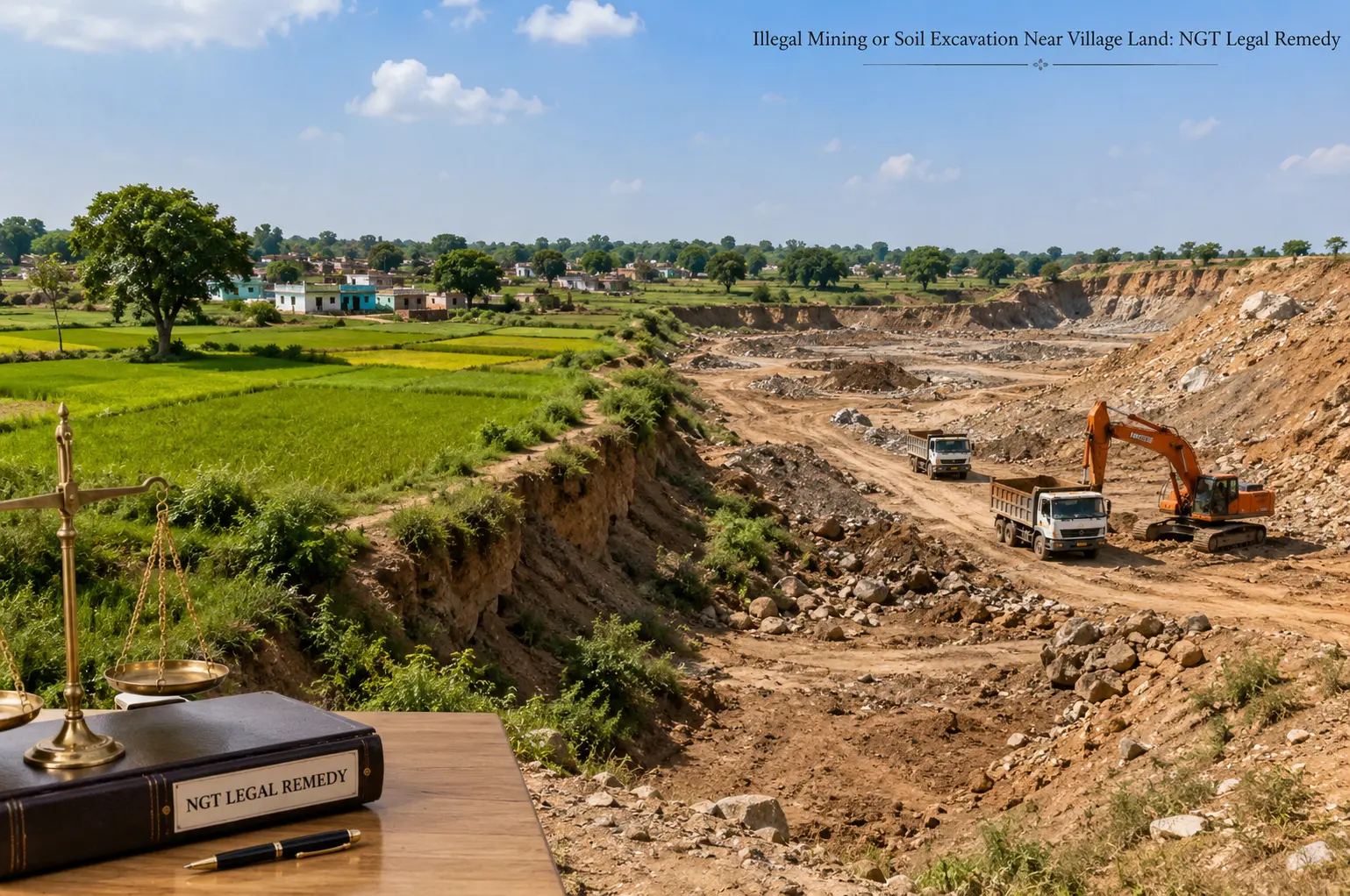
A few tractor trolleys going into a field at night may seem like a village fight. In weeks, the same tractor trolleys can create a large excavation pit that causes environmental damage. This can damage the village road, break a pond bank, clog drains, dump flying dust on homes or create a real danger to cattle, crops and groundwater. Illegal mining or soil excavation near village land may be a revenue dispute. More seriously, it can raise an environmental concern if digging takes place on agricultural land, common land, riverbed, pond area, forest patch, village pathway, grazing land, water body or affects nearby homes. Many villagers first complain to patwari office, tehsildar, police station, or mining department. Sometimes officials take action. But in many cases, digging continues after one quick visit from authorities. It is appropriate to consider a National Green Tribunal (NGT) legal remedy when: the fight is bigger than a neighbour boundary dispute, involves cutting down trees or grass land, causing environmental damage, extracting soil or minerals unlawfully, creating dust pollution or water contamination, blocking natural drainage, posing risk to public health or damaging common village land. Any villager affected by such extraction, Residents Welfare Association (RWA), farmer organization, panchayat member, NGO member or village land owner can consider legal action before the NGT in addition to filing complaints before the district administration and mining department. Lawyer BK Singh explains this problem very simply. If the soil excavation is causing damage to environment, gather evidence quickly and do not assume it is just a local village fight. NGT Lawyers can guide affected persons and explain whether the facts of their situation support an NGT case, a mining department complaint, a revenue department complaint, a police complaint or a combination of these legal forums. This article gives an overview about NGT legal remedy in India, Delhi NCR and other high-demand regions where rapid real estate construction and village land on city outskirts often conflict. Illegal soil excavation near village land matters in 2026 because it often affects more than one private owner. Public roads, drainage channels, ponds, farm productivity and village safety can be damaged by illegal excavation. Restoration costs and efforts increase when the excavation digs several feet deep. Illegal soil excavation occurs across Delhi NCR because village land borders many new expressways, warehouses, farmhouses, real estate developments and brick kiln supply chains. Soil has resale value. Sand, morrum, gravel, top soil and other minor minerals are often extracted for building construction sites or land filling purposes. Illegal excavation can harm nearby villagers after the damage is done. A villager may not realize there is a problem until cracks appear in the village road, a pond bank collapses, or heavy vehicles drive through residential lanes during nighttime. Even rural families feel pressured not to complain. Some families worry about speaking up if the tractor owner or excavator is politically connected, influential in the village or connected with contractors who have public projects. Some villagers do not want any confrontation. Others think that only the landowner has the right to complain. Legally, that is not always correct if the digging up of soil causes public environmental damage. Illegal mining and digging around village land has become a concern around cities like Hapur, Bulandshahr, Sonipat, Panipat, Agra, Jaipur outskirts, Lucknow rural areas, Kanpur, Prayagraj and Varanasi because farmland expansion, new road projects and private housing construction has skyrocketed demand for soil extraction. Illegal soil excavation disputes are also common around Pune, Bengaluru, Hyderabad, Chennai and Kolkata where village land expands closer to city outskirts. For many affected villagers, the first question is not who owns the land? It is “Does the illegal excavation damage the environment or shared village resources?” If yes, then an NGT complaint may be filed along with the district level complaints. Illegal mining and soil excavation can give rise to environment legal issues, mining legal issues, revenue concerns and criminal law. The NGT will hear civil cases involving a substantial question relating to environment. A compensation claim for personal or property damage may not be enough for NGT filing. Tribunal can grant relief, compensation, damages and restoration of polluted property if loss to environment is proven. DM, local police station, Mining officer, Pollution control Board and tehsildar are other authorities who can take action. Photographic evidence helps. But dated, location proof and official record based evidence is stronger. NGT case is not the solution to every boundary fight or tit-for-tat problem between villagers. If it is purely a private property dispute, NGT will likely refuse the filing. Consult Advocate BK Singh early to avoid losing evidence. Know your correct legal forum before evidence gets destroyed. Illegal mining or soil excavation near village land typically means taking away soil, sand, gravel, stone, morrum, top earth or similar material without lawful authority or permission. This applies to extraction which: Taking out soil for personal levelling may not become an NGT case. Large-scale excavation activity done with JCB machines, dumpers/tippers visiting at night, cutting across village pathway, digging few feet deep, harming natural drainage or irrigation channels, damaging riverbed or causing dust pollution is a different situation. Clients have lost NGT cases simply because they tried filing against the wrong person. The stronger legal case focuses on how the digging up of soil impacts others. Ask: is it lowering down ground level near houses dangerously? Is digging taking place too close to a pond, river, canal or school? Is near a forest patch, road, temple or village houses? Are the extracted materials transported for commercial use? Does the mining operation have any permit or are they misusing permit conditions? Did they cross boundaries and dig on public land? NGT applications become viable when there is environmental harm, need for restoration and accountability. Mining complaints focus on seizure of illegal excavation, transport vehicles and imposition of mining law penalties. Revenue department deals with public land issues, gram sabha land disputes, land records and wrongful possession. Police may get involved if there is theft of minor minerals, forged documents, trespassing complaints, intimidation, non-entry into property or violence. Clients get better results when they use a combination of complaints rather than relying on just one enforcement agency. Lawyer BK Singh does not encourage vague complaints. Filings with proper site map, dated evidence of excavation activity, vehicle registration numbers, land record documents, copies of complaints and local villagers as witnesses are stronger. Illegal mining or soil excavation complaint can raise different legal issues. It depends on impacted resources. Following laws may become relevant: The NGT Act provides opportunity to file case where substantial question relating to environment is involved. Litigants must prove that the issue arises from laws listed in Schedule I of the NGT Act. Tribunal can grant relief or compensation if there is loss or damage to property or environment. Many environmental principles under this Act can also be invoked for restoration and accountability. For illegal mining complaint around village land, NGT route can be used where damage to water bodies, ground water recharge, river beds, loss of forest areas, damage to agriculture ecology, air pollution, impact on public health or other natural resources is proven. Just being irritated by neighbours or local farmers is not enough to file an NGT case. See Also : Gurgaon Camping Ground Illegal Mining Case Verdict : NGT Upholds Joint Committee Report Digging near village land causes environmental degradation or violates conditions of environmental clearance granted for construction projects, factories, mining activities? If so, the Environment Protection Act, 1986 becomes relevant. Mining projects above a certain category also require appraisal or clearance from the Environment Ministry depending on the area of land, type of mineral, state government rules and central government notifications. Mines and Minerals (Development and Regulation) Act, 1957 and state minor mineral rules govern lawful extraction of minor minerals, transport of minerals, storage conditions and mining lease terms. Illegal mining can be seized along with transport vehicles. Penalties, recovery of mineral value and prosecution is usual depending on which State the illegal mining takes place. District Magistrate, SDM, Tehsildar, Gram Panchayat, Pollution Control Board, police and in some cases civil courts are other authorities to approach if villagers are affected by illegal excavation. Illegal soil excavation pollutes water bodies, clogs drains, causes damage to riverbed or flying dust? If yes, concerns under the Water Act and Air Act can arise. If excavation happens in forest land, Aravalli area, eco-sensitive zone, hill land, ridge land, within protected area distance, biodiversity heritage site or near village common land? Each of these locations have additional restrictions against soil cutting or mining. This guide is meant for villagers, farmers, gram panchayat members, landowners near village lands, RWAs affected by excavation activity near rural homes or buildings, residents of colonies which share land boundary with farmland or construction companies/civil works contractors who are wrongfully accused of illegal excavation and mining. Advocate BK Singh has assisted farmers when the land next door is dug so deep that field boundary walls or protection wall becomes unsafe. Village families living along streets through which heavy trucks are brought at night need legal guidance when dumpers and excavators bring dust on homes. Panchayat members can file complaint when excavation damages a pond, johad, talab, grazing land or village pathways which affect entire village. Someone who buys farmland for construction purposes may also need advice when they discover old illegal excavation pits in farmland create problems during future construction or cause property title issues during sale transactions. Illegal mining and excavation near village lands are serious matter around riverbed villages in Noida, Yamuna flood plains areas, villages near Ghaziabad, Faridabad, Hapur or Meerut because taking out sand and earth affect drainage planning, erosion control, flood protection measures and groundwater safety. Areas around stone crusher belts, brick kiln clusters, Bengal villages with high hill slopes or fast urbanising cities around Chennai, Kolkata see similar complaints. NGT Lawyers assist affected villagers, responsible contractors and law-abiding businesses equally. For public welfare complainant needs proof. Wrongfully accused business needs paper trail. Consulting Advocate BK Singh early can help sort out both situations. First identify land and activity. Do not start yelling and attacking men with machines. Start collecting facts. Note down village name, khasra number if known, landmark identification, land type (agricultural, common, leased), what material was removed (sand, top soil, morrum, gravel), machinery used, vehicle registration numbers, timing of activity and estimated depth of pit. Collect evidence safely. Take photos and videos. Do it from a safe distance where you will not get abused or obstructed. Safely distance means you can withdraw yourself if threatened. Do not trespass into private property. Do not threaten labourers. Do not stop or check vehicles physically. Many villagers hurt themselves while stopping a running excavator. If someone is injured during confrontation, weaker becomes larger legal effort against illegal mining because now you have created another issue for police and doctors to handle. Always file a written complaint to District Mining Officer, District Magistrate, SDM, Tehsildar and police station. Send copies to nearby Gram Panchayat. If illegal mining damaged public land, polluted river or caused air and water pollution. Then State Pollution Control Board or State Pollution Control Committee become relevant authorities. After complaints are filed, do not lose acknowledgments. Complaints rejected verbally by police will cost you the case every single time. “We made oral complaint” is easy to deny. Written complaint, speed post acknowledgment, email send and receive report, diary number, photographs and request for inspection are proof that you can produce during NGT hearing. If authorities do not take action or if you feel damage is urgent, then you may consult lawyers to see whether filing an Original Application before NGT is required. Advocate BK Singh files NGT complaints which seek inspection by committee, stop illegal mining, restore land back to original position, claim environmental compensation, penalize erring officers and seek compliance report from each authority. Advocate BK Singh analyses four key questions before advising clients to approach NGT: Clients who just want forum-specific assistance can learn about NGT and tribunal legal help for filing, appearing on behalf, ensuring compliance and fighting environmental disputes. Illegal excavation legal case won’t win without documents. Emotional video calls will not help. Following documents can strengthen your case. Have land records ready. Khasra, khatauni, jamabandi, aks shajra, map of site, revenue site map, civil work demarcation report, field photos before and after mining and ownership documents where available. If land is public gram sabha land or pasture land, get that land record extract or panchayat record extract ready. Identify distance from pond, canal, drain, forest patch, school, temple, road or village houses if excavation takes place near these shared resources. Proper measurements matter. Photos and videos should include land, machinery used, sand loading vehicles or carrier bag numbers, pit depth, location distance from home, water body damage if any, crop damage, damage to village road or dust on home facades. Before and after photograph is golden. If you have filed any complaint, keep copies. Letter to District Magistrate, SDM office, Mines department, local police station, Pollution Control Board, Forest Department office and local gram panchayat should be sent by speed post or email where facility is available. Keep postal receipts. Keep email sent and received reports. RTI reply, surprise inspection report, mining lease details if shared by rogue miner, details of environmental clearance, seizure memo, challans received from police, police station diary number, panchayat resolutions if helping you or out of favor with opposition party, notice from authority. Collect technical site inspection report, drone photography/video of area if available, satellite image, soil testing report, water quality test report or dust sample analysis if serious money and environmental damage is involved. Any accused contractor or person accused of illegal excavation should also keep documents handy. Include lease document, permit or valid extraction reason to show why soil was dug. Transport e-challans, consent to operate documents, environmental clearance copies, site map showing boundary, royalty paid receipt, weighbridge slip, vehicle registration and ownership photo, site photos before and after commencement of work. There are many cases where NGT cases are filed not by villagers. Sometimes legitimate businessmen and companies also require defence against false allegations. Take quick action because once soil is dug, evidence gets destroyed quickly. If one week officials do not visit you, then file a legal reminder through Advocate BK Singh. Lawyers can file RTI and complaint proofsheet. Since NGT matters have limitation (legal deadline to file case) and cause of action (when did harm occur), it is important to track timelines. Sometimes activities continue even after complaints are filed. We look into whether illegal mining activity is continuing, whether excavation is happening during inspection periods and whether there is a history of complaints to prove that the villagers have not kept quiet about the issue. Visit local authorities and file complaint first. DM, SDM, Tehsildar and local police station will take action if illegal mining, wrongful transportation of sand, forged permit is involved. If damage is caused to public land, boundaries are crossed or gram sabha land is illegally encroached upon, revenue authorities should take action after demarcation. Later, NGT may ask these very authorities to file joint inspection report. So your complaint date and action taken report become very important. Record those dates. Expect some delay after complaints are filed. One officer will say mining department case, one says revenue department matter and third officer will say “no problem it’s private land”. Because of this, some affected villagers approach Advocate BK Singh for proper legal advice. Fourteen days to wait is ideal before deciding what to do next. Gather preliminary evidence. File complaints. Wait reasonable amount of time when harm to environment is continuing and then take call on which forum to approach. Do not wait for years when mining and excavation activity continues. Many people fight like a village war. If loss to environment is clearly mentioned in complaint, it is ok to highlight personal and family concerns. Do not make weak complaint without location details. Who complains? “Mining is happening in our village.” This type of vague information is not enough. Authorities want location. Pinpoint the mining site, mention landmark, upload photos and send vehicle numbers. Don’t just provide individual vehicle number. Send fleet numbers also if many vehicles came. Do not exaggerate facts. Pit depth is 6 feet. Do not write its 50 feet deep. Only 5 dumpers came. Do not write at least fifty dumpers came everyday. Environment damage case dies when there is no credibility. Whatsapp voice or video calls will not help. Take videos/photos but file complaints on paper/emails. Keep land records handy. Some people think NGT is land court. It is not. NGT will not decide who owns disputed boundary between two farms. For boundary issues, villagers need to go to revenue authority or civil court. Keep your family safe. Do not become physically confrontative with miners or drivers. Don’t ignore official notice if you are on the receiving end because of illegal mining accusations. Some contractors think “everyone cuts soil“. Penalties and licences will be stopped. Vehicle can be seized. Work on your site will stop. You may lose entire project timelines. Directors, site in-charges, transporters and beneficiaries of illegal land will be questioned. You will have to pay environmental compensation if excavation damage is proven. If you have permit, ensure permit boundary matches with land where mining is happening. If it doesn’t match explain why. If mining is happening on 10 acres but permit is for 1 acre. This is trouble. Don’t lie about permit detail. Don’t ignore technical evidence where needed. Sometimes pictures cannot explain environmental impact. In riverbed cases, groundwater impact, pond or agriculture ecology effects, drilling expert can make case more serious and credible. Ignoring illegal mining or soil excavation around homes can cause serious long-term damage to farmland. Village roads can weaken and collapse due to heavy vehicle movement. Nearby water bodies can dry up or become polluted. Kids, cattle and elderly can fall in deep pits. Dangerous animals may roam if excavation damage affects ecosystem balance. Land owners also risk monetary loss if selling farmland in future. Damage to corner fields may become difficult to use, farm, sale or lease. Damage to shared wall can start neighbour disputes. Future buyers and investors will ask question about physical condition of plot they want to buy. Damage to village land impacts entire community. Common land, pond land, pasture land, natural drain help village family enjoy better living conditions. Damaging common resources can cause flood, dust, water logging complaints during rains. Long term negligence can create health hazards. Local people can file police cases, enter politics and encourage larger group protests. Erring contractors who choose to ignore will lose working days because their vehicles can be seized. Production and project activity will stop. You may fall behind scheduled project timeline. Legal hassles mean loss of money. If environmental compensation is ordered by Tribunal then the business pays more money. Reputation is another big risk if you ignore soil excavation complaints. In small cities and villages, one mining allegation can defame you overnight. Lawful contractor also suffers if records are not updated properly. Delay affects proof of evidence which is why Advocate BK Singh suggests taking quick legal opinion. Do not let small complaints pile up until large. Take call on legal strategy early. Consult an environmental lawyer when : You must consult lawyer if : Consult a lawyer if someone accuses you of illegal mining. Do not wait until vehicle is seized or you get NGT/DM office notice. Take corrective action by reviewing permits, authority documents, ensure boundaries match and permits are updated. Lawyer can guide what documents to submit and reply during enforcement stage. Read natural NGT lawyers defence guide if someone has accused you wrongfully. NGT Lawyers will first identify if matter needs to be filed before NGT or begin with mining department, SDM office, police station, tehsildar, revenue office, Pollution Control Board or civil court first. Waste time and money visiting every authority if lawyer has already told you which authorities are appropriate for your type of case. Lawyers can prepare your complaints, document your evidence, provide legal notice format for authorities and draft NGT application. Potential relief includes inspection by committee, stoppage of mining activity, environmental compensation against erring officers, restoration of land back to original condition, action against non-complying authorities and submission of compliance report. Lawyer BK Singh only drafts what can be proven with evidence. He asks for photographs, site map, land records, proof of complaints. The tribunal is not there to entertain how much you suffered or provide monetary damages without proof. Lawyers also help contractors and mining operators who need legal defence against illegal mining complaint. False may not be all false. Sometimes issue is partly right and partly wrong. Gather your permit and related compliance documents first. Do not argue with accusers. For broader legal advice on environment issues, our dedicated environmental lawyers page can guide citizens, NGOs, RWAs and genuine businesses on their legal rights and how to seek environment and NGT related help. Disclaimer Advocate BK Singh or NGT Lawyers will never promise you that we can get stay order or assure compensation through NGT. Lawyer can analyze facts, guide you on appropriate forum and give you a legally viable action plan. Expect that. Not fake promises. Yes, villagers affected by illegal mining or soil excavation activity near farmland or shared village land can file NGT case. Cases must raise substantial question relating to environment. Illustrative damages or personal vendetta against neighbor does not become an NGT case. No. Digging soil for legitimate land levelling or farm activities may be allowed. But when somebody digs your land without permission, commercially sells extracted material, crosses permitted boundary or does unlawful activity causing damage to environment or public land, then legal issues can arise. Inspection by committee, stoppage of illegal excavation activity, environmental compensation, restoration of damaged area, imposition of penalty on defaulting officers and action against authorities who did not perform their duty are example of relief against illegal mining. Relief in each NGT case depend upon facts and evidence. Approach DM, SDM office, Mines department and police station quickly when you notice illegal mining. Waiting for weeks after filing complaints may weaken your NGT case. Direct NGT filing can be examined when digging is continuous, causes serious environmental harm or officials are not acting despite your repeated complaints. Photographs with date and time, videos recording machinery used and vehicle numbers, land records of nearby farmland where illegal mining occurred, revenue maps showing location and filed complaints are good evidence. General complaints without proof will get dismissed. NGT will not decide private ownership dispute. If NGT case is filed simultaneously for damage to environment, tribunal can hear that application separately. But taking back private land will not be part of NGT orders. Yes. Just because someone obtained mining permission from competent authority does not mean they can excavate beyond mapped area, throw soil on public pond or damage residential area during night. Complaints can be filed against violations and offenders. Keep proof of each complaint or phone call you made to remind officers about mining activity. If filing complaint does not stop continuing environmental damage to your home or farm, then lawyer can send stronger legal notice, file RTI or consider NGT filing asking for inspection by court appointed committee. Companies can also consult lawyers before reacting. Collect all permits, mining lease document, maps if boundary was violated, royalty receipts, vehicle registration details and photos of work site before and after commencement of work. Act immediately if illegal mining continues and there is visible damage to environment. Do not wait for months. Hide proof of excavation if you can but advise clients not to lie because evidence gets destroyed quickly. Get early legal opinion to know which forum to approach. Illegal mining or soil excavation near village land can pose serious dangers to life and property. Ignoring problem as if it’s a local village fight is not advisable. Land damage due to illegal excavation can impact farmland safety, village roads safety, water safety and public health for many years to come. Collect evidence quickly and file complaints in the right forum. Quick action separates strong legal cases from weak spoken or WhatsApp complaints. NGT legal remedy should be used appropriately. It is good forum when environment is affected. Do not file NGT complaint just because your neighbour is doing wrongdoing activities on their farm land. If guilty persons happen to damage environment during illegal excavation, villagers can include NGT application along with complaints before local authorities. Advocate BK Singh and NGT Lawyers understand that affected villagers, RWAs, NGOs, farmland owners and genuine businesses want quick answers. Want transparency from authorities. Following proper legal channel help clients sort out issues faster. Grab evidence if soil excavation is happening near your village land before it’s too late. Disclaimer : This article is meant for general information purpose only and should not be construed as legal advice for taking up any specific case.Illegal Mining or Soil Excavation Near Village Land: NGT Legal Remedy
Table of Contents
Why This Issue Matters in India in 2026
Quick Facts Box :
Understanding Illegal Mining or Soil Excavation Near Village Land: NGT Legal Remedy
The Legal Framework
National Green Tribunal Act, 2010
Environment Protection Act, 1986 and rules made thereunder
Mines and Minerals law
Water Act and Air Act
Forest Department
Who Needs This Guidance?
Step-by-Step Process
Documents and Evidence Checklist
Timelines, Practical Delays and Decision Windows
Common Mistakes People Make
Risks of Ignoring the Matter
When Should You Consult a Lawyer?
How NGT Lawyers Can Help
FAQs
1. Can I file NGT case against illegal soil excavation near my land?
2. Is cutting of soil near my farm always illegal?
3. What kind of relief NGT gives against illegal mining?
4. Should I file complaint to police station first or directly to NGT?
5. What evidence should I collect for NGT legal remedy?
6. Can NGT decide ownership of private land near village?
7. Is it still illegal if they have mining permission but crossed boundaries while digging?
8. Some officers visited us but still they are not taking action on complaint. Now what should I do?
9. Someone made illegal mining allegation against my company. What should I do?
10. How soon should I act after noticing illegal mining activity?
Final Thoughts
Disclaimer
There's no reason for concern. There is no difficult-to-understand legalese.
Someone who has helped many people with the same problems gives you clear, honest advice. We want to make the legal process easy to understand and use for everyone.
Schedule Your Consultation