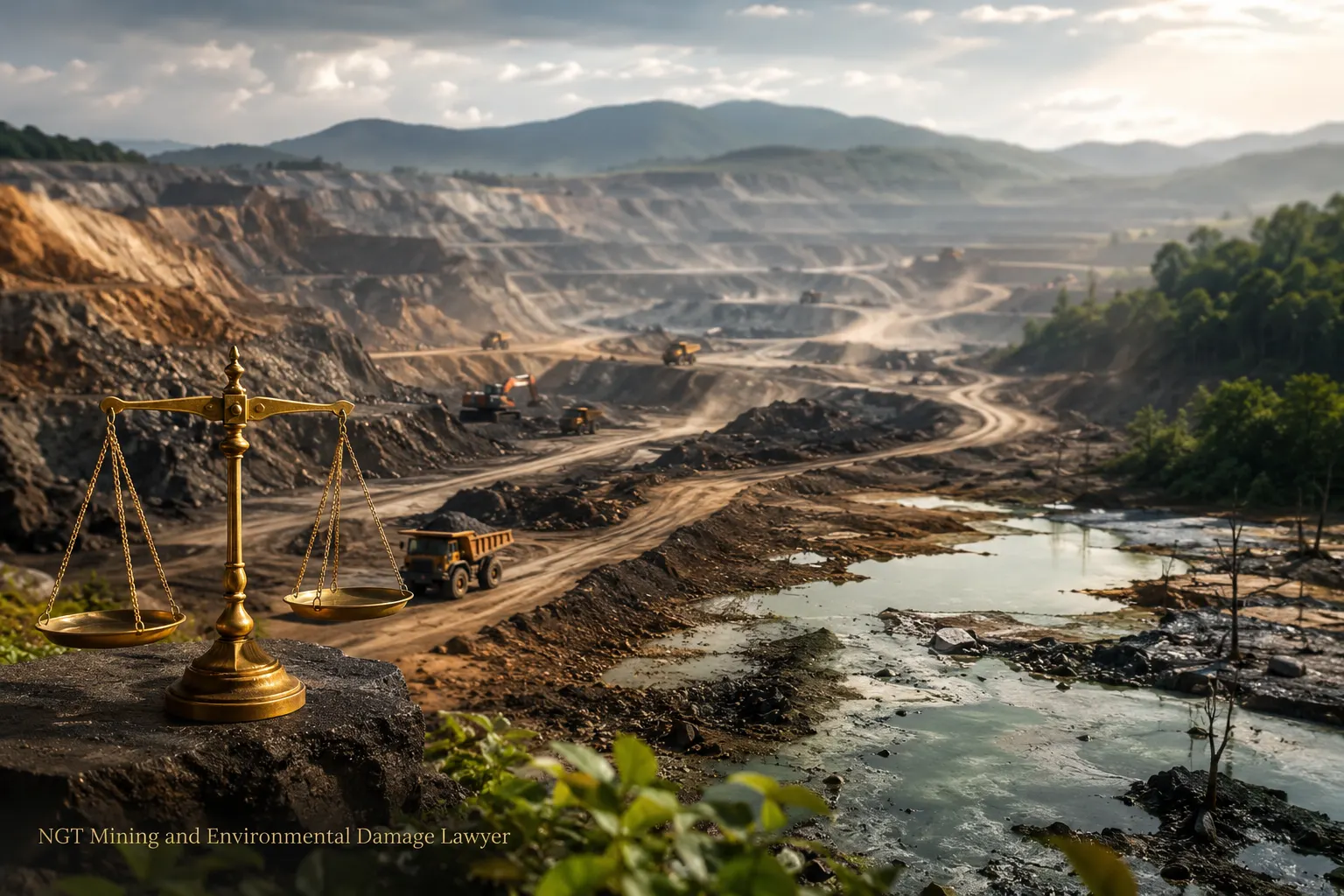
NGT Mining and Environmental Damage Lawyer Mining damage does not come labelled as a legal case on day one. There is dust on crops, visible cracks developing near houses, lowering of groundwater table, trucks moving at odd hours, cutting of riverbed or a hill disappearing bit by bit. By the time citizens realize that something can be done legally, the site is often altered. An NGT Mining and Environmental Damage Lawyer helps common citizens, RWAs, farmers, businesses and affected residents present these facts to the appropriate environmental authority backed with evidence. Illegal mining, unauthorized mining, excessive excavation beyond permit areas, violations of environmental clearance terms, crusher pollution, damage to water bodies or riverbed, tree chopping for mines, dust, unsafe transport of minerals are some examples of mining disputes in India. Citizens from Delhi NCR, New Delhi, Ghaziabad, Noida, Greater Noida, Gurugram, Faridabad, Meerut, Hapur, Lucknow, Jaipur, Mumbai, Pune, Bengaluru, Hyderabad, Chennai, Kolkata and other areas often face the same first challenge – thinking of how to file the case. Their real challenge begins after filing. Proving environmental damage in a manner that National Green Tribunal, pollution control boards and local administration can notice and take action. Advocate BK Singh deals with these cases keeping a practical focus on evidence, choice of forum, urgent relief, asking for restoration and measured legal action. In this article, I explain how mining damage cases work, what documents matter, how NGT jurisdiction can arise and how affected residents can proceed without over claiming or filing weak cases. Mining related disputes are becoming serious because livelihood pressures from urban sprawl, road projects, real estate construction and sand supply chains have started focusing on rivers, hills, village commons and forest fringe land. In Delhi NCR and surrounding areas, citizens usually complain about dust, heavy and overloaded trucks, vehicles moving at night, illegal storage areas, damaged roads and sudden changes in groundwater level and supply behaviour. A mining problem becomes legally relevant when it affects public health, private property, natural resources or environmental rights of people. NGT cases cannot be used for every local fight. Legal action becomes justified when the dispute involves a substantial question relating to environment under any of the applicable environmental laws. Making this distinction is important because weak filing means delayed relief and loss of credibility. In my advocacy practice I’ve noticed one mistake repeated many times: citizens collect emotional complaints but not evidence. They have videos but no date trail. They have photos but not location marker. They know who is operating but not the lease area or permission legality. Lawyers who care about results separate emotion from fact and build a case record. Advocate BK Singh begins by asking 3 questions: Is the mining or sand transportation illegal? If permitted, does it violate any conditions of permission? Can damage be proved with credible material? NGT can hear civil cases involving a substantial question of environment Mining damage complaints can include NGT, pollution control board, mining department, local administration and others Environmental restoration and asking for repairs can be equally important as asking for compensation money Solid proof like geo-tagged photographs, spot inspection reports and lab test data help build a stronger case Illegal mining is different than permitted mining with violations Delay affects limitation, evidence quality and chance of getting interim relief Sending a legal notice is a good option, but serious cases may have to approach the forum directly An NGT Mining and Environmental Damage Lawyer looks at mining, stone quarrying, stone crushing, sand extraction or mineral transportation activity and decides whether there is legally proveable environmental damage. Doing this job includes reading permissions, knowing violations, collecting proof, drafting applications and pleadings, asking tribunal for interim relief and seeking restoration if facts justify the same. Mining damage lawsuits are very technical. Lawyers need to see the facts with environmental law glasses, not just civil litigation glasses. Dust may open the air- quality records. Pollution may need lab tests. Riverbed mining needs maps, satellite images, knowledge of lease areas and district mining office records. Advocate BK Singh asks whether the client complaint can be documented with papers, field material and provable under legal clauses. This approach not only prevents clients from over claiming but also helps the forum understand the real issue faster. A strong NGT filing should not look like a person shouting on paper. Environmental lawyers use many laws at the same time to build a mining and environmental damage case. The NGT Act itself derives jurisdiction from civil environmental disputes connected to specific laws. Section 15 NGT Act is powerful because it allows for relief including compensation, restoration of damaged property and damaged environment. Advocate BK Singh avoids a one-size-fits-all approach to mining damage cases. A riverbed controversy is different than a stone-crusher complaint which is different than raising a boundary violation issue under mining lease. Residents living along mining areas, farmers whose crops are affected by dust, Rajasthan SabhaUnits affected by construction dust, village communities living along riverbeds or extracting sand for livelihood, land owners noticing property cracks, environmental associations, businesses that are accused of wrongdoing andoperators with valid permit but wrongful closure fear – can all seek legal advice. Citizens often try police or local offices first before speaking to a lawyer. Reporting illegal mining can help, but environmental issues require more planning. Reporting to the District Magistrate, local Mining Officer, State Pollution Control Board or local municipality bodies creates a paper trail. However, complaint letters must use the right words. Businesses have different concerns. Sometimes a mine owner, contracting company, transporter or stone crusher operator receive notices from authorities. Inspections, closure order threats, environmental compensation demands and tribunal cases fall under the same worry category. Documents like compliance reports, consent orders from pollution control board, EC terms, effluent monitoring data and voluntary repairs begin to matter. Advocate BK Singh can represent both the affected parties and businesses following the mining laws. Good mining damage cases begin on site. First comes location mapping. Location of activity, operator details, mineral type, kind of machinery used, truck routes, distance from residential area, homes, schools, water bodies, agricultural land and forests. Second comes evidence in a clean sequence. Photo should have date and location. Videos should establish continuity of issue, not just random scenes. Dust, noise or water contamination complaints need technical backing most times. Citizens who file complaints with local authorities before tribunal filing have an added proof that they tried to resolve the issue as responsible parties. Lawyer reviews the evidence and decide which legal route is suitable. Pollution control board requires representation before them first in some matters. Administrative complaints work where authorities are not taking action. Some cases are workable as an Original Application before NGT. Complaint against environmental clearance, specific consent or order from statutorily authority requires a different angle. Advocate BK Singh prepares each case after linking facts to reliefs. If water bodies are damaged, asking for inspection and removal of minerals can be one relief. Stoppage of illegal activity and compliance orders are second. If the act is permitted but violates clearance conditions, seeking enforcement of order conditions becomes third. The prayer or relief section must fit the facts. Casting a wider prayer not based on facts weakens genuine cases. Businesses have different documents. A defence file should include mining lease, environmental clearance, prior consent to establish, consent to operate, approved mining operation plan, transport contracts and permits, weighbridge data if operating a crusher, compliance reports submitted to authorities, reply to inspection notices, reply to show cause notices and ongoing restoration plans if any. Advocate BK Singh also enquires whether the matter requires technical input. Not every mining damage case requires a private consultant, but credible technical material helps matters related to groundwater, dust monitoring, slope damage, riverbed changes or hazardous substances. Time becomes a factor because environmental damage does not remain the same. A riverbed can get refilled by authorities. Trucks can pause operations for a few days. Machinery can get relocated. Dust can settle after rains. This is why collecting evidence early has more value than coming later with emotional and exaggerated complaints. Limitation rules under NGT Act starts becoming important based on the kind of relief sought and cause of action. Cases filed under section 14 NGT Act have different limitation than a compensation or restoration request under section 15 NGT Act. There are separate timelines to file appeals against certain orders. Affected persons should not wait for damage to become permanent. Consulting a lawyer early helps decide whether to send notice, contact authorities, ask for inspection or file NGT application. Advocate BK Singh treats each matter as a strategic timing decision, not a date-driven mandatory requirement. Even genuine mining damage cases get denied because of poor record keeping. Sending an emotional, rude complaint letter without location proof is one mistake. Naming every government authority and every private player without stating their role in the matter is another mistake. Some complainants use only social media videos to file NGT cases. Videos may not prove who violated law. People make these mistakes too: Seeking help from an NGT lawyer can reduce these risks even before you file the complaint. Environmental damage from mining and riverbed activity cannot be ignored for long. Riverbeds become deeper. Nearby structures start developing cracks. Groundwater table falls. Dust affects children and senior citizens health. Soil quality is lost if farm land is used for sand mining. Damage becoming old means losing proof and paying more for restoration. Ignoring notices as a business can be equally harmful. Receiving a notice, harsh inspection report or sudden closure direction requires reply. Otherwise it may lead to environmental compensation orders, operations stoppage, criminal case, cancellation of permit concerns and loss of reputation. A responsible business should not take time to reply to something they may have not done in first place. Environmental lawyers work on the triple mandate of punishing wrongdoing, preventing damage and restoring damaged environment. Sending a well prepared response along with materials showing actions taken can help prove your side of the story. Advocate BK Singh always advises clients to treat early notices and site complaints seriously even if they believe permissions are valid. You should talk to an NGT Mining Lawyer when mining activity causes visible damage to environment, when authorities do not take action on your complaints, when illegal mining/pumping or extraction happens near homes, farm lands, forests or waterbodies and when you as a mining business receive a notice alleging closure, penalty or compensation. Lawyers can also help you before filing a public interest type complaint. There is no harm in filing a public cause but it needs discipline. Public applicant must show locus to file, detail the facts, prove environmental question, describe affected area and attach documents to the application. Claiming huge money without showing damage will be scrutinized. Businesses need legal advice when they receive inspection notice, environment-related show cause notice, adverse lab report, sudden closure order threat, accusation of violating environmental clearance terms, consent violations or NGT order. Advocate BK Singh reviews content and suggest how to respond legally without escalating the matter. NGTLawyers. com is a network of lawyers assisting with environmental disputes, filing NGT applications, compliance issues and urgent environment related relief across India. If you are an individual resident, RWA, NGO fighting mining related environmental damage or a business affected by vague environmental allegations then you can seek lawyer support on this platform. For people looking for environmental lawyers to represent public causes they can read our NGT Legal Services page. For people focussed on filing before tribunal we have the NGT & Tribunal Lawyers page. Reading that page will give you an idea of how NGT filings work and how you can access tribunal focused lawyers. Mining damage complaints around Delhi may require special support since cases come before Principal Bench located in India Judicial Complex, New Delhi. The NGT lawyers in New Delhi page lists lawyers helping citizens and businesses around NGT Principal Bench and Delhi NCR region. Finally, everyone needs a personal analysis of facts before spending money on lawyers. Advocate BK Singh provides case specific advice after understanding evidence, urgency, potential forum and relief available. Please fill the contact form to start discussion. An NGT Mining and Environmental Damage Lawyer reviews mining related environmental damage, prepares evidence for your complaint or NGT application, help respond to notices received from authorities and file for relief such as inspection, stopping illegal activity, restoration of damaged property or environment and demanding compliance from businesses. Advocate BK Singh works on mining damage complaints where the citizen has proofs to back allegations. Blank allegations and aimless petitions get rejected. Illegal mining activity can be tackled before NGT if the dispute raises a substantial question of environment under any of the environemntal laws mentioned in NGT Act. Some complaints can be filed before mining departments, pollution control board or even RWA office. Please refer above checklist. Yes. NGT can issue orders connected to environmental restoration, damage to property, cattle deaths. But your application must clearly seek the kind of relief you want and add material to prove damage, cause and action needed. No civil mining dispute or contract disagreement can go to NGT unless there is a substantial question of environment which needs to be proved. Yes. Businesses usually defend by showing they have permissions from local authorities, follow environmental clearance conditions during mining activity, have consent to establish and operate from pollution control board and follow a mining plan approved by relevant mining authorities. If written complaints do not find response from authorities then you may send them reminders, file RTI applications to gather records, represent to higher officials or file appropriate cases before NGT. Choosing the right forum depends on facts, proof you have, urgency and type of environmental damage. Residents living close to stone crushers can file NGT complaint against dust if crushers violate consent conditions, cause environmental damage and affect public health. Checking distance of crusher from residential area, gathering proof like photos and complaints with panchayat/urban body helps. River bed mining cases should be filed urgently. Site evidence changes quickly when a riverbed is being mined. Trucks and machinery can be moved. Pit can be filled. Water scarcity affects after some time. Getting the proof early and approaching authorities creates paper trail before the mining site is restored by authorities. Advocate BK Singh can guide you on mining damage related disputes by reviewing facts, deciding which authority or forum is appropriate to deal with the matter, preparing your complaint or NGT application, asking for relief and finding out the technical gaps in evidence. Mining-related environmental damage should not be handled casually. A weak complaint may get ignored, while a well-prepared record can lead to inspection, corrective action, restoration or tribunal relief. The difference often lies in timing, documents and legal framing. An NGT Mining and Environmental Damage Lawyer helps convert visible harm into a structured legal case. If mining activity is affecting land, air, water, homes, farms or community safety, early legal review can protect both evidence and remedy. Advocate BK Singh can assist with clear, practical and forum-appropriate guidance across India. This article is for general information only and does not constitute legal advice.NGT Mining and Environmental Damage Lawyer
Why Are Mining Damage Cases Becoming Common Across India?
Quick Facts for Mining & Environmental Damage Complaints
What Does an NGT Mining and Environmental Damage Lawyer Do?
Which Laws Apply to Mining Damage, Pollution and Restoration?
Legal route
Why it may relate to mining damage
NGT Act, 2010
?? NGT filing, claim for compensation money, restoration and environmental civil disputes
Environment Protection Act, 1986
?? Seeking environmental protection directions, triggering pollution control action
Water Act, 1974
?? Water pollution, consent-related problems, conditions of discharge
Air Act, 1981
?? Dust, emissions from crushers, crusher pollution, consent issues for air
Mines and Minerals (Development and Regulation) Act, 1957
?? Illegal mining cases, mining lease violations, guidelines for transport and storage
Environmental Impact Assessment (EIA) Notification
?? Conditions of environmental clearance and compliance
Who Can File Before Damage Evidence Becomes Scarce?
How Does a Mining Damage Suit Progress From Proof to NGT Relief?
Evidence Checklist that Builds Credibility in Mining Damage Cases
What Is the Time Risk in Mining Related Complaints?
Mining Damage Case Mistakes to Avoid
What If Mining Damage Is Left Unaddressed?
When to Talk To an NGT Mining Lawyer?
How NGTLawyers. com Can Assist You?
Frequently Asked Questions
1. What can an NGT Mining and Environmental Damage Lawyer do for mining damage?
2. Can illegal mining complaints be filed before NGT?
3. What kind of proof can I use for mining environment damage case?
4. Can NGT order removal of illegally mined material and restore damage?
5. Can civil mining disputes go to NGT?
6. Can businesses also defend mining related NGT cases?
7. What should I do if pollution control board or officers do not act on my complaint?
8. Can residents file NGT complaint against dust from stone crushers?
9. Are river bed mining cases urgent?
10. How can Advocate BK Singh help me in mining damage related issues?
Closing Note
Disclaimer
There's no reason for concern. There is no difficult-to-understand legalese.
Someone who has helped many people with the same problems gives you clear, honest advice. We want to make the legal process easy to understand and use for everyone.
Schedule Your Consultation