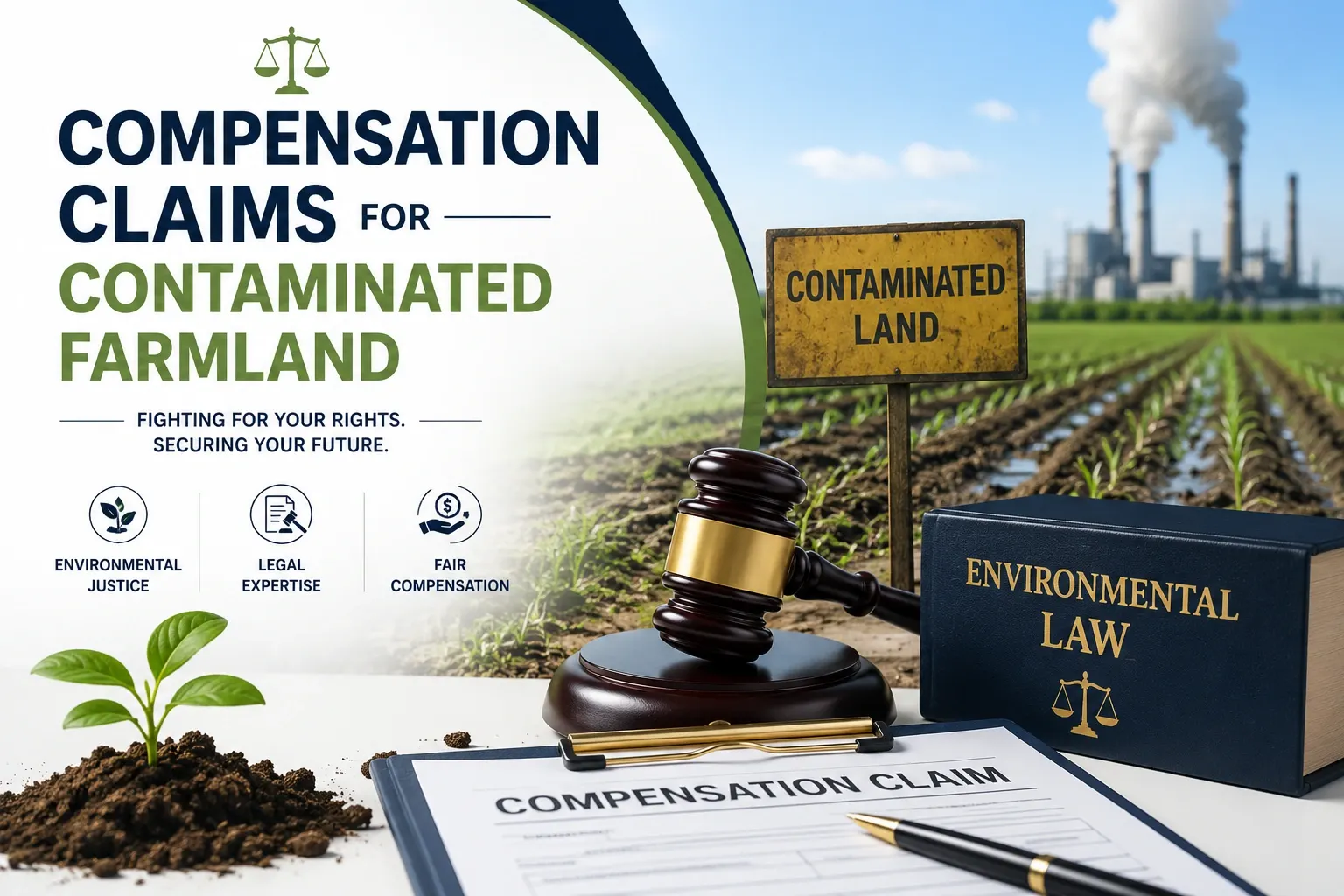
A farmer may notice the damage slowly. The crop looks weak, the soil becomes hard, tube-well water smells unusual, and buyers question the produce. By the time the family connects the loss with industrial discharge, sewage, chemical dumping, fly ash or leachate, one season has already gone. Compensation Claims for Contaminated Farmland are not only about money. They prove pollution has damaged land, crop income, groundwater, land value and dignity. Across Delhi NCR, Noida, Ghaziabad, Faridabad, Meerut, Lucknow, Jaipur, Mumbai, Pune, Bengaluru, Hyderabad, Chennai and Kolkata, farmland often sits near drains, industrial clusters and waste sites. In my practice, I have seen one serious mistake again and again. People keep complaining orally to officers, but they do not preserve soil reports, crop records, photographs and revenue documents. Advocate BK Singh and Advocate Sadhna Singh guide affected landowners, farmers, RWAs, gram sabhas and businesses by building the matter around evidence first, then remedy. Contaminated farmland can destroy income, health confidence and property value together. A field affected by toxic discharge may produce lower yield, unsafe crop quality, poor soil fertility and damaged groundwater. For many families, land is security, identity and future funding. The pressure is sharper around Delhi NCR and growing belts near Noida, Greater Noida, Ghaziabad, Faridabad, Gurugram and Meerut, where agricultural pockets sit close to industrial estates, construction debris sites, sewage drains and waste facilities. Similar disputes arise around tanneries, dyeing units, chemical storage sites, landfill edges and polluted river stretches. A compensation claim must connect three things clearly: the source of pollution, the damage to farmland, and the loss suffered by the claimant. Bare anger rarely works. A strong claim uses land records, scientific testing, photographs, crop history and official complaints. Advocate BK Singh and Advocate Sadhna Singh usually advise clients not to wait for the next failed season before collecting proof. Contaminated farmland means agricultural land whose soil, water, crop quality or productive condition has been harmed by pollutants, hazardous substances, untreated waste, sewage, industrial effluent, ash, chemicals, leachate or other environmental contaminants. A claim becomes stronger when contamination is supported by test reports, visible damage, repeated discharge records, official inspection notes or expert assessment. Many farmers first notice lower yield or crop burning. That may be relevant, but the legal file must move beyond symptoms. It should show how the pollution entered the land and why the alleged polluter or authority should answer. The cause may be private, public or mixed. A factory may discharge untreated effluent. A municipal body may allow sewage to enter fields. A landfill may leak into groundwater. A construction project may dump debris. People searching for legal remedies for water pollution often face the same root problem: water contamination slowly becomes land contamination. Advocate BK Singh and Advocate Sadhna Singh focus on identifying the pollution pathway before drafting the claim. The main route usually begins with the National Green Tribunal Act, 2010. The NGT hears civil cases involving substantial questions relating to environment and enforcement of legal rights connected with environmental protection. Section 15 empowers the Tribunal to grant relief and compensation to victims of pollution and other environmental damage, restitution of damaged property, and restitution of the environment. Section 20 of the NGT Act requires the Tribunal to apply key environmental principles, including sustainable development, the precautionary principle and polluter pays principle. In simple words, a person or unit that causes environmental harm may be required to bear the cost of damage, control and restoration, depending on the facts. The Environment Protection Act, 1986 matters where emissions, discharge standards, hazardous substances, inspections, sampling and official directions are involved. The Water Act, 1974 becomes relevant where contaminated water, drains, streams, wells, groundwater or effluent discharge affects farmland. The Air Act may enter the picture where dust, fly ash or emissions damage crops. For strategic review, Advocate BK Singh and Advocate Sadhna Singh examine the environmental law route alongside revenue, property and civil consequences. A compensation claim may suit farmers, agricultural landowners, lease cultivators, village communities, gram sabhas, family landholders, farm investors, nearby residents, cooperative groups and businesses whose agricultural land has suffered measurable pollution damage. The claim may also concern future cultivation risk, not only past crop loss. Families in Delhi NCR and adjoining areas often approach lawyers when polluted water starts entering fields from a drain or industrial belt. In other regions, the trigger may be a chemical spill, factory discharge, ash pond leakage, landfill leachate, illegal dumping, untreated sewage or contaminated borewell. Urban expansion has made these cases more common near boundaries between farms and commercial hubs. The claimant should act when the damage is repeatable, visible or scientifically traceable. Crop sale receipts, mandi records, khasra-khatauni papers, soil reports and neighbour statements may help. Advocate BK Singh and Advocate Sadhna Singh check whether the matter is best placed before NGT, pollution authorities, civil court, writ court or a combined route. The first stage is fact capture. The affected person should record the source, date, smell, colour, flow direction, crop condition, drain path and visible spread of pollution. Photographs and videos should show location, landmarks and dates where possible. Random images without context often create confusion. Next comes document building. Land ownership or cultivation rights must be shown through revenue records, lease papers, possession proof or family documents. Crop loss should be supported through sowing details, old yield records, bills, mandi slips and seed purchases. Soil and water testing should be done through credible laboratories where feasible. The third stage is authority engagement. Complaints may be sent to the State Pollution Control Board, CPCB, DPCC in Delhi, district administration, agriculture department or local body depending on facts. A well-written complaint can seek inspection, sampling, stoppage of discharge, identification of polluter and preservation of records. Where the issue needs Tribunal intervention, the matter may move through proper drafting, affidavits, documents, photographs, maps and relief clauses. The NGT e-filing process can help parties understand structured filing. Advocate BK Singh and Advocate Sadhna Singh align the prayer with both compensation and restoration, because farmland cases should not end with only a cheque if the land remains poisoned. Evidence must answer four questions: whose land is affected, what pollution occurred, who caused or allowed it, and what loss followed. Without that chain, a genuine case may still look incomplete. Advocate BK Singh and Advocate Sadhna Singh often ask clients to arrange old photographs of healthy crops too. They help establish contrast. Crop insurance documents and tube-well electricity bills can also support the economic picture. Delay can damage a contaminated farmland claim. Under the NGT Act, limitation differs by the nature of proceedings. Claims for relief, compensation and restitution under Section 15 are generally tied to a five-year window from the cause of action, with limited scope for condonation if sufficient cause is shown. Dispute applications under Section 14 have a shorter limitation structure. The real difficulty is identifying when the cause of action arose: first discharge, crop loss, test report, official inspection or continuing pollution? The answer depends on facts. Courts and tribunals examine pleadings carefully, so casual drafting can create limitation problems. A practical decision window is shorter than the legal window. Soil conditions change, crop seasons pass, drains get cleaned, and polluting units may alter records. Advocate BK Singh and Advocate Sadhna Singh advise early legal mapping, especially where the polluter is powerful or the damage is spreading. Many claimants complain to the wrong office for months, then approach a lawyer after the damage becomes difficult to prove. Some rely only on oral statements. Others collect soil samples without maintaining location details or chain of custody. A few accept informal assurances from the polluter and lose the best evidence period. Another common mistake is asking only for compensation without asking for restoration, inspection, future monitoring or stoppage of discharge. A farmer may receive temporary relief but face the same pollution next season. In industrial belts, parties also forget to obtain consent records, closure directions, waste movement details and previous complaints. Some owners exaggerate loss without documents. That can weaken credibility. A careful claim should be firm, not inflated. The legal story must match the land record, crop record and scientific material. For pollution control issues, Pollution Control Lawyers can help assess notices, compliance gaps and authority responses. Advocate BK Singh and Advocate Sadhna Singh also check whether urgent interim relief is needed. Ignoring contaminated farmland can convert a recoverable claim into a long, uncertain dispute. Soil may lose fertility, crop buyers may avoid the produce, borewell water may become unusable, and the market value of the land may fall. Families also face pressure when farm income supports education, medical costs or loan repayment. From a legal angle, delay allows the opposite side to say that the claimant accepted the condition, failed to mitigate loss, or cannot prove the source. Authorities may also treat old complaints as stale unless the damage continues and is properly documented. That is why a written evidence trail matters. Public bodies may need direction to inspect, stop discharge, clean drains, remove waste or restore affected areas. Private polluters may need to answer for compensation and preventive measures. The environmental compensation notice guidance on the same domain is useful for understanding how compensation issues are approached in practice. A lawyer should be consulted when pollution is visible, crop loss repeats, officials delay inspection, the polluter denies responsibility, or test reports show abnormal contamination. Legal advice is also needed when a notice, closure direction, compensation demand, village dispute or land-value issue has already arisen. Early consultation does not always mean immediate litigation. Sometimes the right first move is a well-drafted complaint, evidence preservation letter, legal notice, request for inspection or coordination with technical experts. In serious cases, urgent relief may be required to stop discharge, protect crops or prevent further dumping. Advocate BK Singh and Advocate Sadhna Singh can review facts, identify the forum, close document gaps, and decide whether the matter should move as a pollution complaint, NGT application, compensation claim or combined action. For broader environmental litigation support, NGT Lawyers provides assistance across India. NGT Lawyers can help by studying the land documents, pollution source, scientific material, authority complaints and financial loss pattern before recommending a legal route. The work begins with evidence, not dramatic allegations. That approach helps the claim survive scrutiny. Advocate BK Singh and Advocate Sadhna Singh assist with legal notices, pollution board complaints, NGT pleadings, document indexing, interim relief strategy, compensation prayers and restoration-focused relief. Where required, they coordinate with technical reports, photographs, maps and inspection material. The service is useful for farmers, landowners, village groups, RWAs, developers and commercial landholders who face contamination disputes. For river-linked and drain-linked cases, the page on River Pollution Case Lawyer in India may help readers understand wider pollution litigation. Advocate BK Singh and Advocate Sadhna Singh keep the relief realistic: stop the harm, prove the loss, seek restoration, and claim compensation where legally supported. Yes. A farmer or landholder may claim compensation if pollution has damaged agricultural land, crop yield, groundwater, soil condition or property value. The claim must be supported by documents and evidence. Advocate BK Singh and Advocate Sadhna Singh can assess whether the matter fits NGT, pollution board, civil or combined action. The National Green Tribunal is often the key forum where the dispute involves a substantial environmental question and relief, compensation or restoration under environmental laws. Pollution Control Boards and local authorities may also play a major role. Forum choice depends on source, evidence, location, urgency and relief required. Useful evidence includes land records, crop history, photos, videos, soil reports, water test reports, complaints, inspection records, crop sale receipts and maps. The stronger the connection between pollutant, land and loss, the better the claim. Yes. Environmental claims may seek restoration of damaged property and the affected environment, not only monetary compensation. In farmland cases, restoration can be critical because the family may need the land for future cultivation. Relief depends on expert assessment, pollution source, feasibility and forum discretion. Limitation is very important. Compensation and restitution claims under the NGT Act have specific time limits, and delay may invite objections. The starting point can become disputed in continuing pollution matters. Affected persons should preserve proof and obtain legal advice early. Yes. Groundwater contamination can support a farmland claim if it affects irrigation, crop quality, soil condition or usability of agricultural land. Water testing, borewell records, photographs and complaints to authorities become important. The claim should show how contaminated water reached or affected the farmland. Multiple affected farmers may act together if the pollution source, affected area and relief are connected. Collective claims can show wider impact, but each claimant should keep individual documents. A combined approach may help where a drain, industry, landfill or authority affects several fields. A claim may still be possible if a municipal body, development authority, public utility or government department allowed sewage, waste, leachate or polluted discharge to damage farmland. The pleadings must show duty, failure, damage and relief needed. Public body matters require careful drafting. A soil test report is not the only document, but it is often one of the most useful pieces of evidence. Water testing, crop records, photographs and official inspections may also support the claim. In serious matters, scientific testing should be done carefully. Crop loss can be claimed if it is linked to pollution and supported by credible records. Past yield, mandi receipts, input bills, photographs, agricultural advice, revenue records and expert assessment may help. The amount is not automatic. It varies with proof and forum findings. A legal notice can help when it demands stoppage of pollution, preservation of records, inspection, compensation and restoration. It also shows that the affected person acted promptly. In urgent cases, direct authority complaint or NGT filing may be more suitable. Denial is common. The claimant should rely on inspection requests, photographs, drain mapping, sample testing, consent conditions, past notices, local complaints and expert findings. Advocate BK Singh and Advocate Sadhna Singh help structure evidence when the opposite side denies responsibility. Yes. Contamination may reduce market value because buyers fear poor soil, unsafe water, future litigation and restoration cost. Land-value loss can be relevant, but it needs valuation support and proof of contamination. The claim should separate crop loss, restoration cost and property impact. No. Some complaints may be better handled first through the State Pollution Control Board, local administration or another authority. NGT is suitable when the dispute involves environmental law, substantial environmental questions and appropriate relief. A lawyer should assess facts before choosing the forum. NGT Lawyers can review documents, identify the legal route, draft complaints, prepare NGT pleadings, seek inspection, frame compensation prayers and push for restoration-focused relief. Advocate BK Singh and Advocate Sadhna Singh also help clients avoid weak allegations by building the case around records and scientific proof. Compensation Claims for Contaminated Farmland need speed, discipline and proof. Affected families should not wait until every crop fails or every officer ignores them. The stronger approach is to preserve evidence, test soil and water where possible, file proper complaints, identify the polluter and seek legal guidance before limitation and issues grow. A good claim does not only ask for money. It asks for stoppage of pollution, restoration of damaged land, accountability, future monitoring and fair compensation where the law supports it. Advocate BK Singh and Advocate Sadhna Singh can help affected landowners and farmers across India prepare a careful, evidence-led claim before the appropriate forum. This article provides general information only and should not be treated as legal advice for any specific contaminated farmland claim.Compensation Claims for Contaminated Farmland
Polluted Farmland Is Not Just an Agricultural Loss
Quick Facts on Compensation Claims for Contaminated Farmland
What Counts as Contaminated Farmland Under Indian Environmental Law?
Which Indian Laws Support Compensation for Contaminated Farmland?
Who Should Consider a Compensation Claim?
How Does a Farmland Pollution Claim Move From Evidence to Relief?
Documents That Make or Break the Claim
Document Type Why It Matters Khasra, khatauni, registry or lease paper Shows ownership, possession or cultivation interest Soil and water test reports Links contamination to measurable scientific data Crop records, bills and mandi receipts Helps show income pattern and loss Photographs, videos and maps Explains source, flow and affected area Complaints to PCB or administration Shows timely action and official notice Inspection reports or notices Supports regulatory breach or failure How Much Time Do You Have to Act?
Errors We See in Real Contaminated Farm Cases
What Happens if the Damage Is Ignored?
When Should You Consult a Lawyer?
How NGT Lawyers Can Assist
Frequently Asked Questions
1. Can a farmer claim compensation for contaminated farmland in India?
2. Which forum handles Compensation Claims for Contaminated Farmland?
3. What evidence is needed for a contaminated farmland claim?
4. Can compensation include restoration of soil?
5. Is limitation important in contaminated farmland matters?
6. Can groundwater contamination support a farmland claim?
7. Can multiple farmers file together?
8. What if the polluter is a government body?
9. Are soil test reports compulsory?
10. Can crop loss be recovered?
11. Can a legal notice help before filing?
12. What if the factory denies discharge?
13. Can contaminated farmland reduce land value?
14. Is every pollution complaint fit for NGT?
15. How can NGT Lawyers help with this claim?
Closing Note
There's no reason for concern. There is no difficult-to-understand legalese.
Someone who has helped many people with the same problems gives you clear, honest advice. We want to make the legal process easy to understand and use for everyone.
Schedule Your Consultation